
As we approach 2024, lets unravel some buzzwords you’ll hear constantly over the next 12 months. The star of the show: “AI Agents”. This is a simple dive into this complex yet fascinating part of the AI revolution.
Definition:
An AI agent is a digital assistant capable of autonomously observing, assessing, and interacting with its environment to make decisions and take actions.

Disclaimer: The writing is 100% me, however the ideas are not: I’ve included a list of sources that I’ve used at the end of this article (and a handy list of AI Agents currently available).
Understanding AI Agents:
The term “agent” in AI derives from “Agency” –the ability to act independently and make free choices. This concept dates back to 1973 with the “Actor model” proposed by Carl Hewitt, Peter Bishop, and Richard Steiger. In this model “actors” – Fundamental units of computation – could make decisions, send messages, and replicate if required. Now, fast-forward 50 years and a lot has changed. Today’s AI agents are built on sophisticated language models and trillion-parameter deep networks. Big players like Apple, Meta and Google are pushing forward for AI hardware on mobile devices, making an AI agent future more than just tech buzz.
Why AI Agents are a big deal:
AI agents are central to most modern AI ethics debates. Hopefully the reason will be obvious by the end of this article, but just to kick things off, a thought: we still don’t fully grasp how deep learning, a key part of this AI revolution, works. Yet, we’re moving towards granting these AI systems more autonomy. Why? Simple: The economic potential is staggering. Teams working on AI agents are not only securing multi-billion investments but are also the hotbeds for the best and brightest minds in technology.
Follow the money? Okay, here it is: I think AI agents have the potential to revolutionize society. When futurists discuss AI, they’re almost always painting a picture of a world where AI has agency.
Consider the implications of a few “off the top of my head” scenarios:
- What happens to retail when AI agents are managing shopping from start to finish?
- Or “the Office” when young professionals produce top-tier professional work on their first day, thanks to AI agents?
- Or our economy, when AI agents take over personal finance management, moving us beyond impulsive “use credit card/buy shiny stuff” decisions?
- Or try Consultancy services getting replaced by a billion-dollar AI model’s advice (plus agents generating everything from presentations to prototypes before lunch)?
(Or Google, once we reach the tipping point of AI doing more clicking and searching than humans)
It’s clear: I think this is going to be a big deal, let’s jump into what it actually is:
Exploring AI Agents: Types and Functions
There is a lot of disagreement in the AI sector as to what an Agent actually is, I think this can be attributed to investments and trends. (from AutoGPT to AutoGEN, we’ve come a long way in a year). But let’s bring it back to our original definition which is centered around the concept of agency and autonomy.
In “Artificial Intelligence: A Modern Approach” by Stuart Russell and Peter Norvig, AI agents are divided into five types, each more advanced than the last:
- Simple Reflex Agents: Operating on basic rules.
- Model-Based Agents: Able to build and use models of their environment.
- Goal-Based Agents: Focused on achieving specific objectives.
- Utility-Based Agents: Making decisions based on outcome desirability.
- Learning Agents: Evolving and improving through experience.
Dave Shapiro offers another perspective on the next generation of Automation:
- Digitally mirroring physical operations.
- Working within digital networks.
- Interacting through standardized interfaces like APIs.
- Operating autonomously, without human intervention.
- Streamlining complex processes.
Shapiro argues that creating collaborative, specialized agents to solve complex problems is now almost trivial. (I humbly agree, we’ve prototyped multi agent frameworks and the output easily justified the effort).

The Hurdles Ahead
Despite the promise of this future, significant challenges remain:
- Technical Limitations: Tools like Microsoft’s Co-Pilot highlight current tech constraints perfectly. (Everyone is going to be noticing this in the next few months. My humble opinion: focused AI projects and small models are the way to go)
- Ethical and Safety Concerns: No one is ready for an AI Agent partner and the impact it has when your credit card maxes out. And I’m not even touching the subject of AI and warfare.
- Accountability: Addressing issues similar to those faced by autonomous vehicles. Who pays the bill when a glitch in an AI Agent offloads an entire investment portfolio?
- Opacity: A lack of understanding of AI’s internal workings. Autonomy needs more control and understanding.
- Human Influence: The potential for AI to significantly impact human decision-making. How much autonomy are we willing to offshore?
“Moravec’s Paradox” is another hurdle. The paradox is named after Hans Moravec, a researcher in the field of robotics, who noted that it is comparatively easy to make computers exhibit adult-level performance on intelligence tests or playing checkers, and difficult or impossible to give them the skills of a one-year-old when it comes to perception and mobility. Yann LeCun talks about this at length in some great interviews, and it’s a very real problem. (one that literally thousands of researchers are working on at this very moment)
Final Thoughts
I don’t think 2024 will see AI agents being fully integrated in our daily lives, however I do think that many of the major challenges will be overcome in the next 12 months. Creating a foundation for the second generation of agents that use multiple models and technologies in parallel. Which in a way takes us all the way back to the actor model of 1973.
plus ça change, plus c’est la même chose?
In this case, probably not.

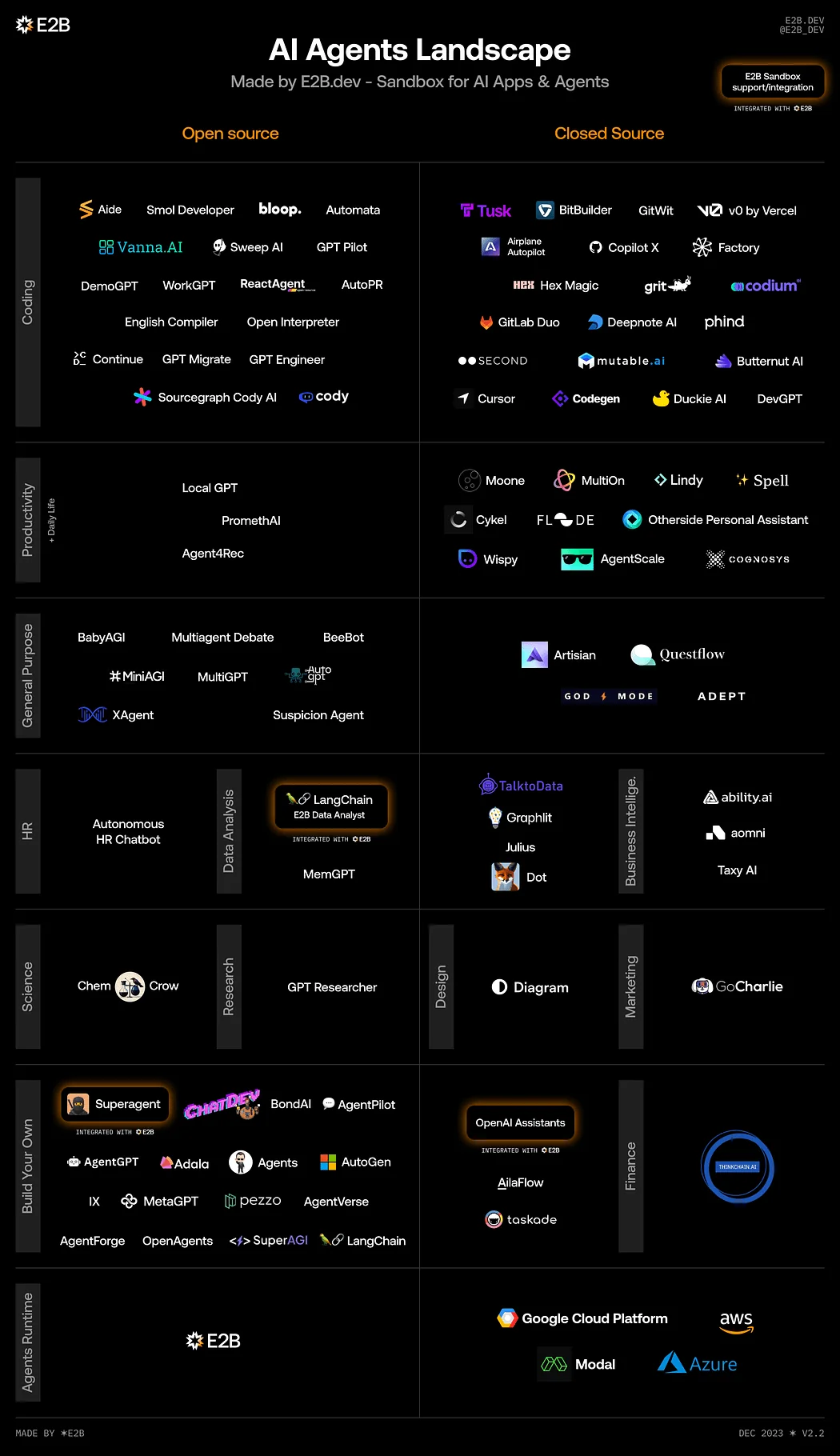
AI Agents List: (credit to E2B.dev)
e2b-dev/awesome-ai-agents: A list of AI autonomous agents (github.com)
Sources:
6 Types of AI Agents: Exploring the Future of Intelligent Machines (simform.com)
The road ahead reaches a turning point in 2024 | Bill Gates (gatesnotes.com)
a critical look at Moravec’s paradox: Moravec’s Paradox Comes From The Availability Heuristic — LessWrong
Actor Model: Here’s an incredibly helpful animation to explain:
Understanding Deep Learning : Here’s a great video from one of my favorite channels : https://youtu.be/sJXn4Cl4oww?si=PCKXOUPTiySPCMhu
Understanding Deep Learning: Prince, Simon J.D.: 9780262048644: Amazon.com: Books)
Trillions up for grabs according to rockstar investor Cathie Wood (pinch o salt ?)
Global AI spend 2024 What Will 2024 Hold In AI Advancements? (forbes.com)
From machine learning to autonomous intelligence: https://www.youtube.com/live/pd0JmT6rYcI?si=-j8Spp4B5XS6OGCd
Dave Shapiro, Agents + swarms: https://youtu.be/IqovGsaTro8?si=km9JS8XYje27GgTM