It’s a cold sunny Sunday afternoon in Amsterdam, and after a run along the gorgeous Amstel River and a (ridiculously expensive) haver-cappuccino, I read that Anthropic's language model cracked a huge mathematical problem: the Riemann Hypothesis https://alpo.ge/remark.pdf.
There are a few fundamental questions to be asked here, like: “How could the model, built around matrix multiplication, even know if it’s got the answer right?” I’m not even going to attempt to understand the higher order mathematics, but I can write about some of the concepts at work here and explain how a model and all its math agents can work on, and solve, a problem like this.
I’ll do this using a combination of history, primary school mathematics, high school philosophy and a pinch of computer science.
I think it’s an important question to dissect because it sits in and around the definition of intelligence and it has more than a few philosophical components. With regards to intelligence: Most of the facets, functions and definitions of intelligence we know have a shared property in that there is outcome where the person or system gets it right. The question I’m asking today from a computer is “show me how you got to that correct answer”, or in primary school terms, “Prove it, kiddo!”
The philosophical rabbit hole is vague, but worth exploring because it aligns us with the field of AI and probabilistic outcomes. I’ll skip the squirrelly world of axioms and circular logic, where the person asking the question and the answer are all affecting each other in a cloud of probabilities. The simple question is: “What is correct, anyway?” I’m of the opinion that it’s all just degrees of certainty. So the second question then becomes: can you prove the route to the answer, where each step made along the way has a high enough degree of certainty that the route becomes acceptable proof for the answer and it can be used for generating the correct answer for new and unique questions?
The question and its answers have a history, a theory and a machine: “The Logic Theory Machine” and it’s an important first step to understand if you want to know more about the field of AI and partially understand how the heck these language models are solving mind numbing math problems.
So, let’s start with a simple mathematical foundation of logic theory:
Question 1: Why is every whole number ending in zero divisible by five?
Well, step one is checking the division (okay, it works). The basics are verified.
Let’s give it a spin and find a proof:
| Number | Divide by 5 | Multiply to check |
|---|---|---|
| 30 | 30 ÷ 5 = 6 | 6 × 5 = 30 |
| 7,240 | 7,240 ÷ 5 = 1,448 | 1,448 × 5 = 7,240 |
| 123,450 | 123,450 ÷ 5 = 24,690 | 24,690 × 5 = 123,450 |
Every division produces a whole number with no remainder, which proves divisibility.
And simply put: Any whole number ending in zero is a multiple of 10. Since 10 = 5 × 2, it must also be a multiple of 5.
What I’ve done here, in logic theorist terms, is found a bridge to a goal.
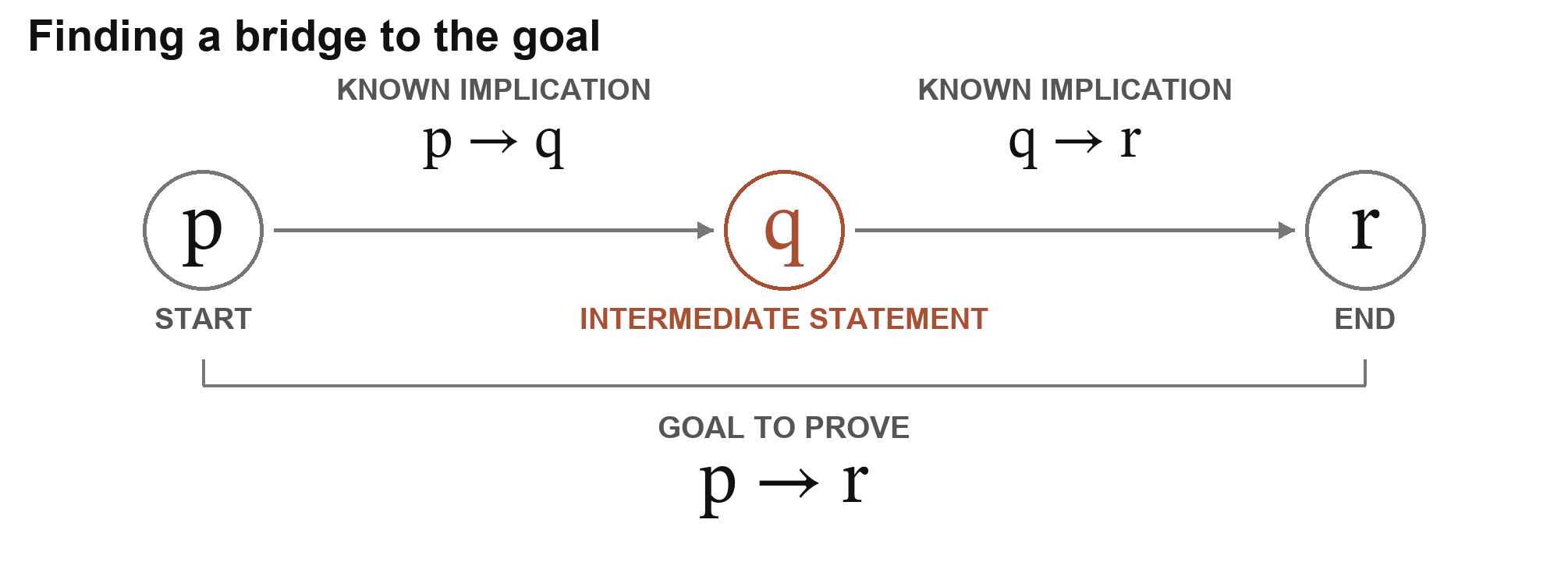
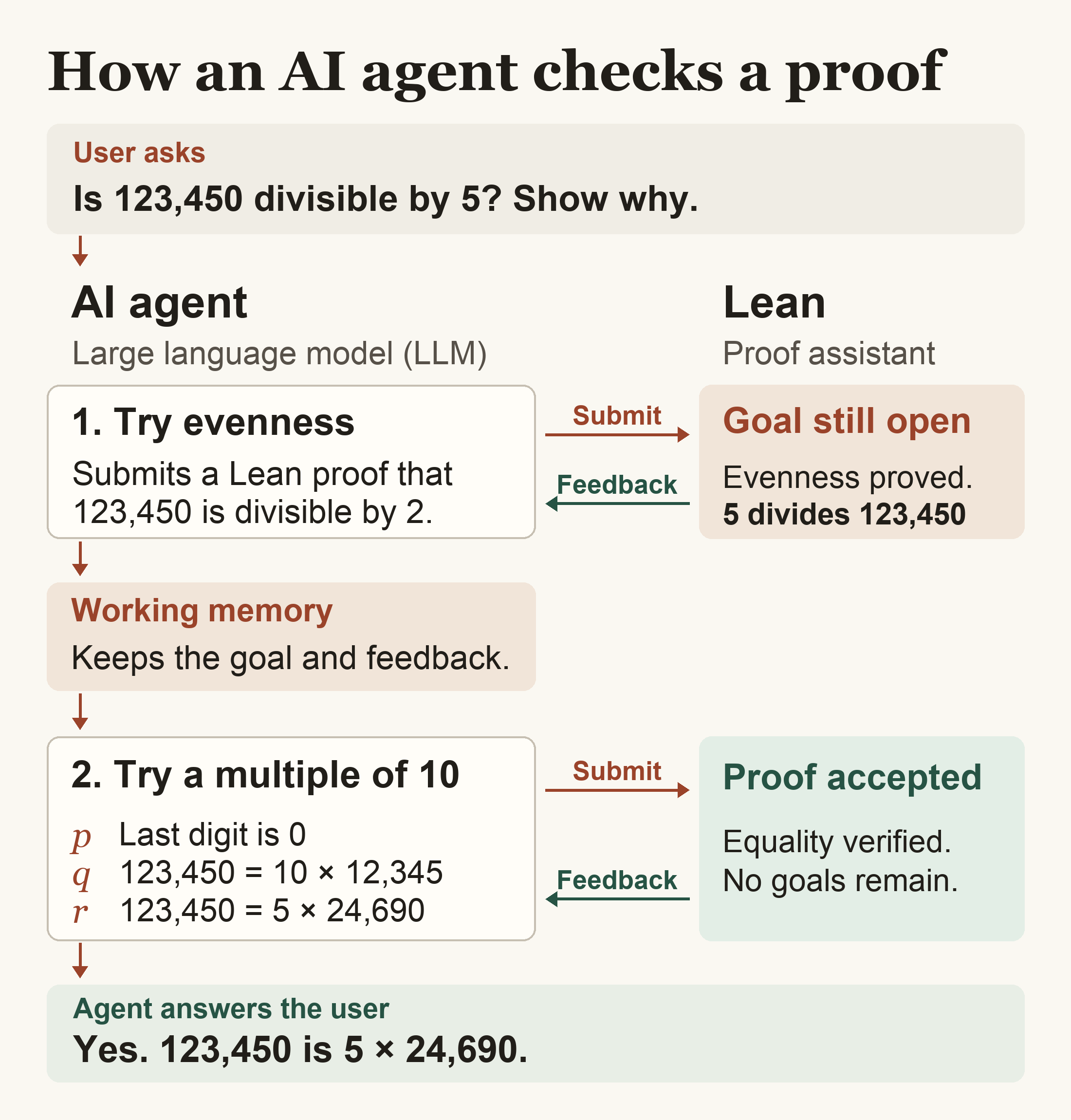
Each letter in the diagram stands for a statement about the same number. p means it ends in zero, q means it’s a multiple of ten, and r means it’s divisible by five. An arrow means “implies.” If we know p is true and that p implies q, then q follows. Logicians call that move modus ponens. For 123,450, we use it twice.
- From p to q. In base ten, any whole number ending in zero is a multiple of ten. Since 123,450 ends in zero, it’s a multiple of ten.
- From q to r. Every multiple of ten is divisible by five, because ten is twice five. So 123,450 is divisible by five.
Once you see the middle step, the proof is easy to check. But how would a computer find that step in the first place?
The Logic Theory Machine faced that problem when it searched for proofs in symbolic logic. One of its methods, called chaining, looked for an intermediate statement that could connect the starting point to the conclusion. In our example, “is a multiple of ten” makes that connection. The program used heuristics, or rules of thumb, to decide which possibilities to try first. Its rules of inference determined whether each step in the resulting proof was valid.
So where did Logic Theory and its machine come from? unfortunately (like most of the history of AI) we are back to the wonderful world of the US defense industry. Check out my last article on Norbert Weiner and Cybernetics for more anti-aircraft algorithmic “goodness”.
In the early 1950s, Allen Newell and his research group were studying how the crew of an air-defence station made decisions. For the exercise to work, the crew needed to see where the aircraft were. The laboratory had no way to make blips move across a radar screen. It did, however, have a printer. Together with programmer Cliff Shaw, he created a program that printed a succession of maps with a mark on the map to symbolize the position of an airplane.
Herbert Simon, a political scientist working with the group, was interested in what the crew did with that information. People making a decision seldom have time to examine every option. How do they pick one worth pursuing? Newell had encountered a similar question in the work of the mathematician George Pólya. The basics of that work was: Read a finished proof and every step might make sense. Cover the next line with your hand, though, and it can be remarkably hard to say what belongs there (anyone that has studies LLMs and masking data should have a lightbulb moment now).
By 1955, Newell, Simon and Shaw had found a way to study that moment of decision or hesitation. Just as a mark on a map could stand for an aircraft, a symbol in a computer could stand for a statement. They could give a machine a few statements to start with, tell it which deductions were allowed and set it a conclusion to reach. Then they could watch how it found its way from one to the other. They called their program the Logic Theory Machine, also known as Logic Theorist.
The next logical step:
For their next experiment, the three chose problems from Principia Mathematica, Alfred North Whitehead and Bertrand Russell’s attempt to build mathematics from logic. The book gave them something a radar simulation with a blip problem never could. For each problem, the authors had already set out the bridges for them. Principia Mathematica already had a sequence of reasons showing why the conclusion must follow from the starting assumptions. The researchers could give the program the same destination and see whether it could find a route.
“Find a useful middle step” is excellent advice if you already know which step is useful. To turn it into a program, the researchers had to specify which symbols to compare and what to do when a promising match led nowhere. In January 1956, in a Pittsburgh classroom, Simon and Newell tried their instructions on members of Simon’s family and at least one graduate student. Each person had a card and played one part of the program. Nine-year-old Barbara served as its memory for theorems. Her older sister Katherine recorded branches of the search on the blackboard. Between them, they kept track of what the program knew and what it still had to work out.
On RAND’s computer, that blackboard became a programming problem. Trying one step could open a smaller question, and answering it might mean returning to a question set aside several moves ago. Shaw helped develop a language in which the program could build and rearrange lists as it ran. A new question could go on a list along with a record of where it belonged. That organisation of simple acts such as remembering, comparing and choosing was what Newell and Simon called complex information processing.
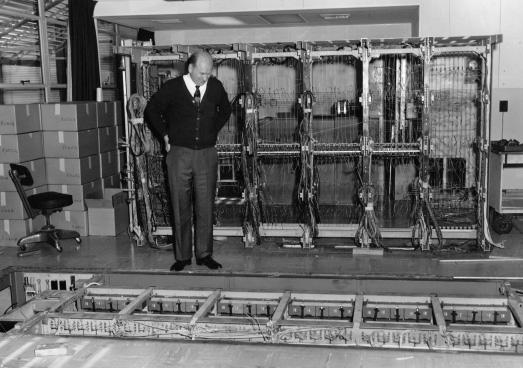
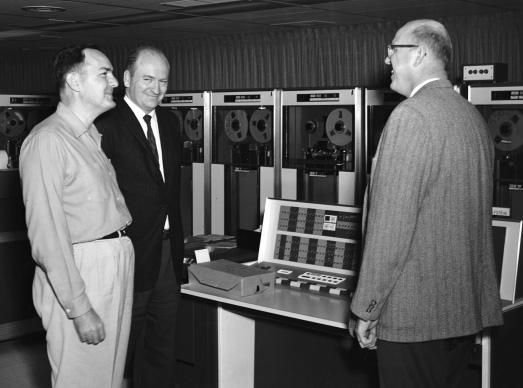
By the summer of 1956, the program ran on RAND’s JOHNNIAC computer, named after the mathematician John von Neumann. That same summer, researchers at Dartmouth met to discuss whether machines could perform tasks associated with intelligence. The organisers used a name they had proposed for the field the previous year, artificial intelligence (AI). Anyone wondering what that might mean in practice could now look at the steps of an actual machine-found proof. In October, Simon wrote to Russell to tell him that a computer had proved a theorem from his book (the 1950s version of what happened this week with the Riemann Hypothesis).
“I wish Whitehead and I had known of this possibility before we both wasted ten years doing it by hand,” Russell wrote back.
This week we heard similar feedback from mathematicians:
Andrew Sutherland —
“An AI that can prove the Riemann hypothesis is not one I’d want to meet.”
James Maynard —
“If this fully checks out, it is clearly a historic milestone in mathematics.”
Maksym Radziwiłł —
“The object of mathematics as the rest of science is really the question ‘why?’ and this doesn’t answer it at all.”
When there is no answer, and no book or bridge
Let's fastforward past the AI winter to 1996, computer scientist William McCune’s program settled a question that mathematicians had been trying to answer for decades. Did three rules proposed for a kind of algebra imply all the usual laws of Boolean algebra? The program found a sequence of deductions showing that they did. Readers could check the argument step by step even though nobody had known that sequence beforehand. A machine searching among permitted moves had added a result to mathematics.
McCune’s proof showed how far a well-directed search could go. It also gives us a way to ask what changed with the arrival of language models. Logic Theorist’s designers had written advice about promising moves directly into their program. Could a machine learn some of that judgement from examples? Researchers working on language had developed a way to learn a different kind of next move. They trained machines to predict what came next in a passage of text. By 2020, large language models (LLMs) trained on text could continue a passage from a prompt. Such a model generates a small piece of text, called a token, at a time. Its training helps it estimate what could plausibly come next given what it has read so far.
A line of mathematical argument can be one of those continuations. Given our question about zero and five, a model might suggest looking at multiples of ten. It might also produce a beautifully grammatical sentence about even numbers. Both observations fit the conversation. Only the observation about tens is the one we want. To make use of such suggestions, the system needs some way to try one and find out how it went.
In 2022, the researchers behind a method called ReAct showed how a language model could choose an action, receive information from outside itself and use that information in its next attempt. In one of their experiments, the action was looking something up. For mathematics it could be submitting a proposed step to a proof checker. A model that can take actions through tools and use the results is part of what is commonly called an agent. The question for a proof-finding agent is what it does with the answer it gets back.
Let’s have a look at a modern agentic reasoning system and how it would solve our simple zero and five problem.
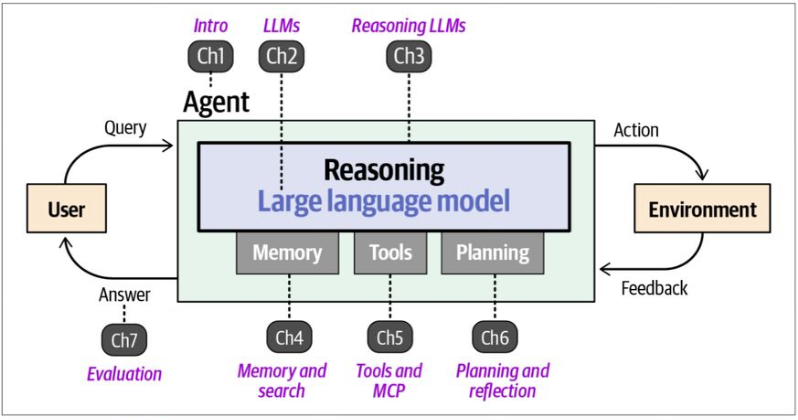
Suppose the user supplies our divisibility problem. The agent first tries evenness and uses a tool called a proof assistant, such as Lean, to check the argument. It must give Lean a version written in the precise language Lean understands. Proving the number is even can be a perfectly valid step. The original goal, proving that five divides it, is still open. That unfinished goal can travel back to the model along the feedback arrow.
On a second attempt, the agent can keep the original goal in memory and change its plan. This time, it expresses the number as ten times some whole number. Twice that many fives make the same number, which is exactly what the checker needs. The model can revise its attempt without being retrained. What has changed is the information it has about this particular proof.
Katherine Simon’s family blackboard example is a cool comparison. Both systems need to keep track of unfinished business. The early team programmed ways of looking for the next step. A language model can propose one from patterns it has learned, and a tool can establish whether it works. In a difficult problem, the most valuable proposal may be something the person who posed the question never mentioned. In geometry, it can be as small as one extra line.
Here’s what it looks like in a nutshell:
Once a proof is on the page, its origin and its validity become two questions a reader can ask separately. Russell could follow the steps of a machine’s proof. A mathematician can do the same with the argument. Finding out how anyone saw the crucial step takes a different kind of evidence. That was what made Newell, Simon and Shaw’s experiment so foundational to what we are seeing unfolding today.
I hope this helps explain at least some of the concepts and history behind this week’s news. One thing’s certain: nothing is slowing down.
Thanks for reading,
Kai
AI and mathematical proof, 1956–2026
1956–2025
- 1956–57 · The Logic Theorist. Allen Newell, Herbert Simon, and Cliff Shaw’s program found proofs of known theorems in Principia Mathematica. It used rules of logic to build proofs and heuristics to decide which steps to try.
- 1996 · The Robbins problem. The automated theorem prover EQP showed that every Robbins algebra is Boolean, settling a longstanding open question about the rules of Boolean algebra.
- 2022 · Faster matrix multiplication. AlphaTensor found a way to multiply two 4 × 4 matrices in binary arithmetic using 47 multiplications, down from 49.
- 2023 · The cap set problem. FunSearch constructed larger sets of points with no three on a line in a finite grid. It improved a known lower bound on how large such a set can be.
- 2024 · Olympiad maths at silver level. AlphaProof and AlphaGeometry 2 solved four of six International Mathematical Olympiad problems. In the geometry problem, AlphaGeometry 2 introduced an extra point that helped unlock the proof.
- 2025 · Olympiad maths at gold level. Gemini Deep Think solved five of six problems within the competition time limit. An OpenAI research model also solved five in a separate evaluation.
2026
- 3 February · Fel’s conjecture. AxiomProver found a proof of a conjectured formula about numerical semigroups, which are sets of whole numbers closed under addition and missing only finitely many numbers.
- 20 May · Erdős’s unit-distance conjecture. An OpenAI model found arrangements of points in which the number of pairs exactly one unit apart grows faster than Erdős predicted. The counterexample disproved his conjecture. The exact maximum remains open.
- 10 July · The cycle double cover conjecture. GPT‑5.6 Sol Ultra found a proof that, in a graph with no bridges, you can choose a collection of cycles that covers every edge exactly twice. A bridge is an edge whose removal disconnects part of the graph.
- July · The Jacobian conjecture. Levent Alpöge and Claude Fable 5 found a three-variable polynomial map that can be reversed in a small neighbourhood around each point but has no single inverse for the whole map. It disproved the conjecture in three or more variables. The two-variable case remains open.
- 13 August · Progress toward the Riemann Hypothesis. An AI-assisted proof raised the known lower bound on the proportion of zeta-function zeros that are simple and lie on the critical line, from about 42% to more than two-thirds.
- 4 September · Fermat’s Last Theorem in Lean. Claude produced a complete computer-checkable version of the existing proof, following the mathematical route established by Andrew Wiles and Richard Taylor.
- October · Proof search across open problems. DeepMind reported that its proof-search agent resolved 9 of 353 selected Erdős targets, counting parts and variants, and proved 44 of 492 conjectures about integer sequences.
- 17 November · Two problems in black-hole physics. Anthropic reported that Claude Fable 5.2 proved an abrupt phase transition in one mathematical model of quantum gravity and established an exact bound in another problem in the field.
- 20–21 November · The Riemann Hypothesis. Levent Alpöge released a Lean proof developed with Claude. The Lean and Mathlib communities independently verified the formal statement and proof the next day. As of 22 November, the Clay Mathematics Institute still listed the problem as “Unsolved.”