This week has seen an unprecedented acceleration in the field of artificial intelligence and its commercial applications. After a few (relatively) uneventful months everything is moving and changing again at an exponential rate. As someone who lived in a “pre-internet + pre-smartphone” world I’ve long accepted the concept that government legislation will always lag behind technological innovation. There are numerous examples of this in the public domain, but by and large, in my lifetime at least, lawmakers just don’t “get” technology.
Artificial Intelligence just makes things worse, it is operating in a realm where we barely have a human or biological definition of the key concepts, let alone the technological variants. The question: “What is Intelligence?” borders on entrapment, where the person who attempts to answer inevitably does so incorrectly. When we can barely define a technology another challenge emerges, who owns the output of the technology and how do we align this with a countries legal systems ?
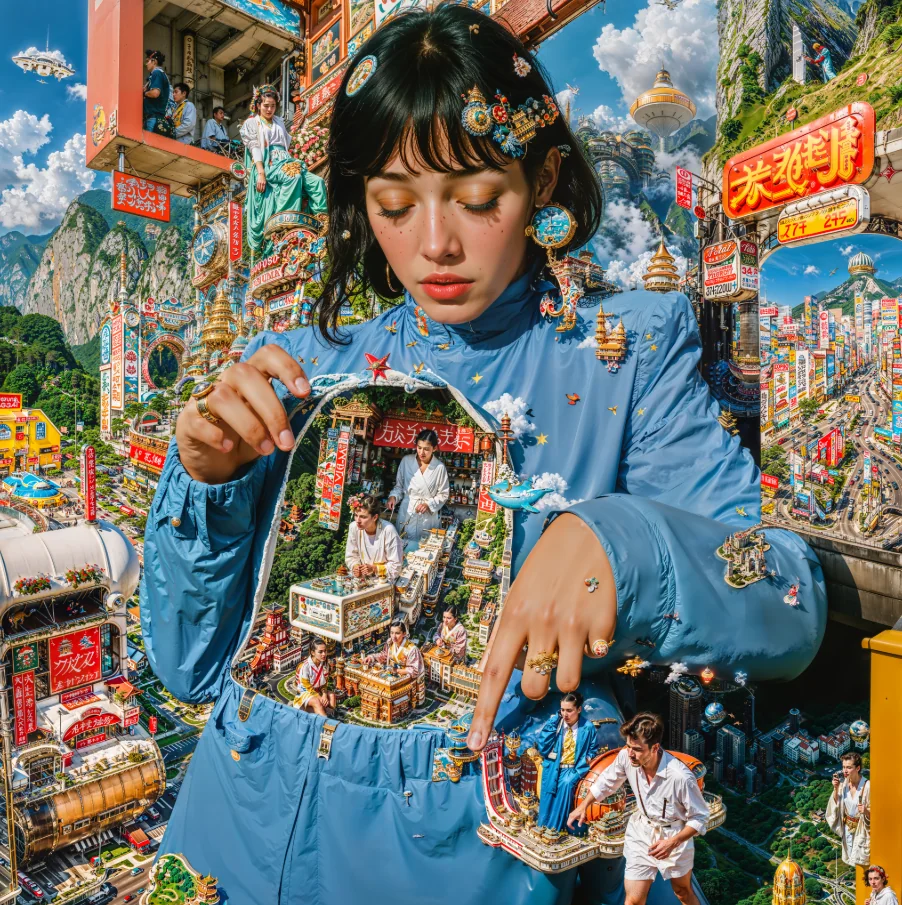
(all this gorgeous art is made by Infiniteyay https://superrare.com/infiniteyay#top)
The United States Copyright Office, has attempted to answer this question: read the linked source
While I have no legal credentials, I can speak about the Generative AI context and to be fair, I agree with the outcomes of this report.
Here’s a NotebookLM Podcast generated based on the report:
https://notebooklm.google.com/notebook/a5220dd4-fcec-4acf-8761-4091baa0e2d1/audio
The interesting point here is that the report focusses on a threshold of “authorship” within the context of AI in a way that looks forward and certainly isn’t behind the times or technology. Credit where credit is due in my humble opinion.
(all this gorgeous art is made by Infiniteyay https://superrare.com/infiniteyay#top)
Okay so here’s the (50/50 AI + Kai) summary of the key take aways from the report.
The Core Principle: Humans Remain Essential:
- Human authorship rules the day. According to the Copyright Office, copyright protection hinges on a uniquely human touch. Pure AI-generated pieces don’t qualify for protection.
- Why it matters: Writers, musicians, artists, and other creatives can take comfort in knowing that their original creations still set the legal gold standard. For businesses and tech developers, it clarifies that software alone doesn’t reap copyright privileges.
When AI Assists vs. When AI Creates:
- AI as a helper: If an artist or coder uses AI to streamline their work — maybe to edit a photograph or brainstorm new plot lines — those final creations likely remain copyrightable. After all, they’re still guided by human vision.
- AI as the main driver: But if the system independently generates the piece with minimal human involvement, there’s no legal protection. A mere “make me a spaceship” prompt doesn’t grant someone copyright over whatever the AI spits out.
- Why it matters: This distinction helps photographers using AI filters, musicians experimenting with AI mixing, and designers using AI-driven mockups understand when their creative labor is — and isn’t — protected.
The Prompt Paradox:
- More detail, more claim? The Office acknowledges that intricate prompts might reflect human creativity. For instance, typing layer upon layer of specific instructions into AI could influence the final result more deeply.
- The unpredictability factor: However, because AI can yield wildly different outcomes from the same prompt, claims to authorship get murky. If we can’t fully predict or control the AI’s output, can we truly call it “ours”?
- Why it matters: Anyone who relies on AI prompts — marketers, content creators, R&D teams — faces a gray area. The more direct and original the human guidance, the safer the claim to copyright.
Around the Globe:
- Varied approaches: The UK grants limited rights for computer-generated works; the EU, like the U.S., stands by the need for human creation. China is exploring entirely new legal frameworks.
- Why it matters: For multinational companies, creators, and policymakers, this mismatch means keeping an eye on shifting rules across jurisdictions. Copyright in one country might not translate to another.
Why Not Expand Protection?
- Protecting human creativity: The Office worries that extending copyright to AI outputs could undercut human talent. A machine might generate a sea of content, overshadowing the work of genuine creators.
- Avoiding monopolies: Big tech firms developing AI models could end up controlling massive swaths of content, stifling healthy competition.
- Why it matters: Regulators and legal experts want to ensure a balanced ecosystem where technology propels innovation without sidelining human artistry.
Looking Ahead
- No immediate legal shakeups: The Office sees no need for new laws right now. Existing frameworks provide a decent roadmap — just look to the established requirement of human ingenuity.
- Case-by-case approach: Determining whether an AI-influenced piece counts as “human-made” should happen one creation at a time. No blanket rule can cover every creative nuance.
- Continuing guidance: The Office pledges ongoing research, best practices, and clarity for creators, developers, and businesses alike.
Thanks for reading,
Kai