
As a regular person, working a white-color office job, pushing zero’s and ones back and forth on a screen (at varying tempos and mostly powered by overpriced coffee) I don't expect to have many “wow” moments in a day; And yet here I am, sitting behind a computer, tapping buttons on an AI service and “wow”, I mean “WOW”. No wait, it’s more: “Wowwwwwwww”
What got me going? Version 5 of the Suno model, a generative AI music service that helps with, songwriting, remixing, covering and creating tracks. I’ve been too busy lately to explore this kind of tech, but every now and then, whether during doom scrolling, or via music loving friends I'd get sent AI remixes. You've probably heard this before, like this Youtube video, where a classic 90's grunge track by Alice in Chains is transformed into 70's Motown style soul:
It's impressive, funny and weird all at once, but still nothing more than a brief distraction and certainly of limited artistic value. A year ago, I tried version 3.5 of this service, and it was genuinely awful. Unlistenable even. Piano chords were smooshed together in a way that sounded like the pianist had fallen asleep with his foot on the sustain pedal, after randomly hitting notes for 3 minutes. Beats straight out the adult entertainment industry, were dumped into the mix. And somewhere in this tonal swamp, a synthetic voice- making Auto-Tune sound like Emma Kirkby, was screeching in a flattened voice. “I’m an AI model, but I have feelings too”.
I closed the browser and swore I'd never subject myself to that kind of aural torture again
It's autumn 2025 and a lot has changed. Musicians like Mono-neon are jamming along with Suno backing tracks. Friends keep saying “Man, you have to try this” …and yes, Yacht rock remixes are everywhere.
A sucker for punishment, I logged into the Suno site, dropped ten euros into the slot machine of the latest generative music model and pulled the lever. https://suno.com/
My reaction was, without hyperbole, very close to pure creative joy.
Over the past few evenings, I’ve been taking unfinished musical sketches I wrote ages ago and asking Suno to add instruments I can’t play, nudge me in a creative direction I'd never have considered, and compose entirely new sections that link (coherently) to my original ideas.
The effect? “wow”, I mean “WOW”. No wait, it’s still: “Wowwwwwwww”
Art is from the amazing: https://superrare.com/grif
A quick walkthrough of how I use Suno:
My workflow is simple, but the real joy comes from playing along with unexpected sounds, beats and compositional structures the Suno service generates. And to be honest I think this process is applicable to other uses beyond music.
Let’s start with expectations: I'm not asking Suno to write a complete song for me. I’ve played music for well over 30 years, studied it and still perform in bands. Suno is a tool, not an artist or an entity – Any talk about an "Intelligent assistant" is pure marketing fluff.
Side note: Dutch master bassist Theo de Jong describes the role of the tool in the creative process perfectly in this video:
This conceptual starting point applies to almost any generative AI task you can imagine. ChatGPT, Gemini or <insert random LLM name here> aren't your accountant, therapist, personal assistant and writing coach rolled into one. Sure, they'll perform plenty of tasks that look like they are. But you really need some foundational knowledge to make them in any way useful.
Otherwise you are basically just “random answering” your way through life, and the odds of that working out are about the same as the odds that it wont.
To formalize this concept a little: This branch of machine learning is called “Generative Modelling”. It involves training a model to produce new data that resembles an existing dataset.
For example, imagine we have a dataset containing thousands of recordings of Bach compositions. We can train a “Suno-like” generative model on Bach to capture the rules that govern the complex relationships between note frequencies, the spaces between sounds, and the way his pieces are performed. By modelling those rules, we can (at least in theory) create a new Bach-like composition, something that didn’t exist in the original dataset or the mind of this demi-god of modern music.
But note the “like” part of that sentence carefully, because there’s a big disclaimer baked into that word. The machine learning algorithm, or “AI,” if you prefer, isn’t being creative. It’s simply identifying statistical correlations and patterns and reproducing them as new data.
Some people, who are much smarter than I'll ever be, argue that machine learning models can detect patterns that surpass human capabilities. Others, equally brilliant, counter that humans can perceive patterns that no machine can match.
Let’s skip that debate entirely and move on to making music.
Expectations and definitions out of the way, lets move on to Step 2:
The idea.
My first shot at Suno wasn’t just some rambling idea. I had chords, a bass line, a melody, and all the basic structural elements of a song. I learned a long time ago that intent is a crucial part of any creative process, and it seems to be just as essential when working with a generative model.
AI in any form is a technology that thrives on clarity. If you don’t know what you want the output to be, it’s often better to reframe your starting point. For example, instead of asking for one specific track, you could ask the model to give you “10 random ideas,” explore those options, figure out what resonates, write it down, and then return to the model for the next step.
Here’s an example of a bass line and some elements of a song I sketched ages ago but never really finished.
I wrote this up to a certain point and saved it online for future reference. It’s pretty clear, though, that I’m a bass player writing a song + this was me as a player ten years ago. The track is “weighted” around a central bass line, and the other ideas are just copy paste samples and some synth lines, they aren’t creatively in balance with that one core bass element.
Back then, my ambition (with this sketch) was to create:
- A Larry Graham 70s vibe
- A jazz fusion big band/orchestral composition
- A groove that makes people bounce their heads (and maybe more)
Unfortunately, somewhere between my creativity, skills, and time management, the song stalled here. I’m happy with what I have, but I have no idea how to write for a big band or an orchestra. If I want a guitarist or drummer to play the line in my head, I’d have to hum or sing it—meaning a lot will get lost in translation. That’s not necessarily a bad thing; it creates space for interpretation and other people’s creativity. Still, as a bass player, I’ve hit a wall.
Once I've defined my high level intentions the next step is zooming in from concept to arrangement, down to the level of individual instruments. I need musicians. I need to communicate with them as a bandleader. That means explaining (or writing) parts for each instrument, laying out the building blocks while still keeping a sense of continuity and vision.
To give you an idea of what I was thinking for the instrument arrangements:
Drums: Play a solid, danceable groove that complements the bass line without clashing with a busy kick pattern. Keep it steady and out of the way of the core rhythm that the bass is supplying.
Strings: I want soaring strings in that classic 70s “Love Boat” orchestral-funk vibe—legato lines that track with my short synth recordings.
Horns: They should function as part of the rhythm section. Use the main groove as a backing line that builds toward a crescendo, with the sax solo closing it out.
Each of these instructions is an axiom filled with subjectivity, but they’re also grounded in my experience as a musician—and this is where generative modelling really comes into its own. Ten years ago, an AI system would likely have used discriminative modelling—essentially an intelligent labeller. We’d feed it examples and tags like “funky,” “bass,” or “swing,” and over time it would learn to assign those labels to new data.
So when I say, “I want the guitarist to play a sixteenth-note percussive funk line in G minor,” each part of that phrase maps to data the model has seen; it could then surface matching samples from a library. That’s useful, but my request has a complexity that demands modifying the material across multiple variables. This is where generative modelling takes over.
It’s not a stretch to say generative modelling offers a richer, more granular grasp of the same data. Because it must generate new sounds that fit my requirements, the model needs to internalize patterns at the level of individual frequencies—the “sonic pixels”—rather than stop at higher-level categories and hand me a pre-baked sample that may or may not fit my arrangement.
The process of music creation doesn’t stop here. Once I commit these elements to “tape” (or record them), I also need to think about how I want the final recording to sound. Using a reference track is often the easiest way to establish that direction. At this stage, it’s just as important to know what I don’t want in the recording as what I do.
As a recording engineer, I want:
- The mix to sound big — this is orchestral 70s funk.
- The bass to be tight and compressed.
- Reverb, but not too much.
Now I have spent a little bit of time figuring out what I want Suno to do, I have all the ingredients for a solid AI collaboration.
I’ve written a sketch of the music, so it’s not just the AI generating background muzak from its training data.
These are clear creative pathways the model can follow toward an output with well-defined requirements.
With that foundation in place, I upload the track into Suno and use the “Cover” function.
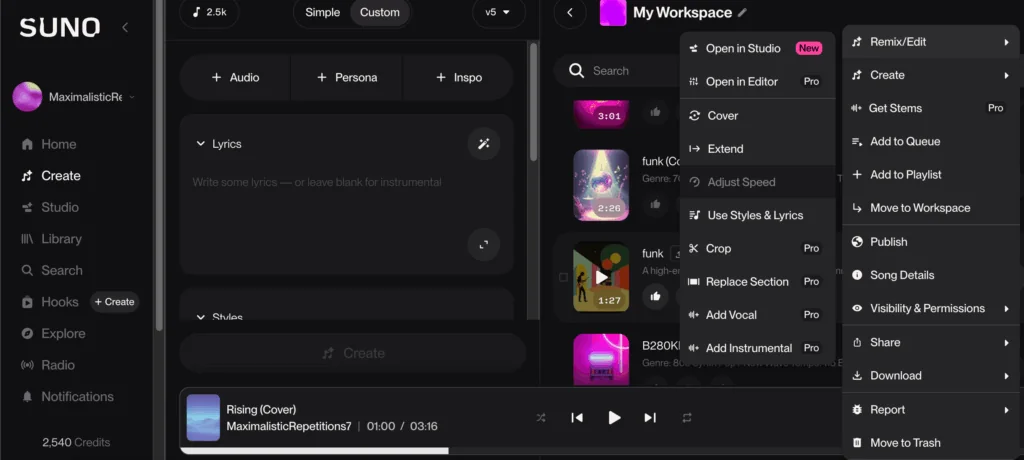
Now I need to talk with the machine. Here's my prompt :
Genre: 70s Funk / Jazz Funk / Orchestral Funk
Tempo: 105 BPM
Mood: Gritty, powerful, high energy, dirty groove
Instruments: Full horn section (trumpets, trombones, sax), lush disco strings, clavinet, wah guitar, electric piano, funky bass, tight drum kit, congas, sax solos
Details: Hard-hitting 70s funk with thick horn riffs, syncopated rhythm guitar, slap and funk bass, orchestral string hits, and dirty jazz solos. Think big band funk — high energy, raw, sweaty, and cinematic.
Exclude Styles: heavy reverb, synths, EDM drums, autotune vocals
If I'm remixing a track I've already written, I don’t want to ask the model to restructure anything. But if something's missing, if I wasn’t inspired or I feel like exploring some new structural ideas, I can define the structure of the remix more deliberately, like this:
Structure: Intro (drums + horns) → Verse (groove + rhythm section) → Chorus (full band hits) → Bridge (horn solos) → Final Chorus (big funk explosion)
And 30 seconds later, this is what it generated:
From here, I have the next iteration of my sketch. I love it—but good god, it’s cheesy. On top of that, the compression on the data is so aggressive you can actually hear the frequencies being squashed. I need to take this output and rework it. And, for now at least, I’m still a better bass player than Suno.
The next step is to split the AI audio sketch into its component tracks. You can do this in Logic Pro, in Suno itself, or with third-party apps. In my experience, Suno’s built-in splitter gives the cleanest result.
No matter which tool you use, you’ll get transients—but that’s not a big deal. It’s just a sketch.
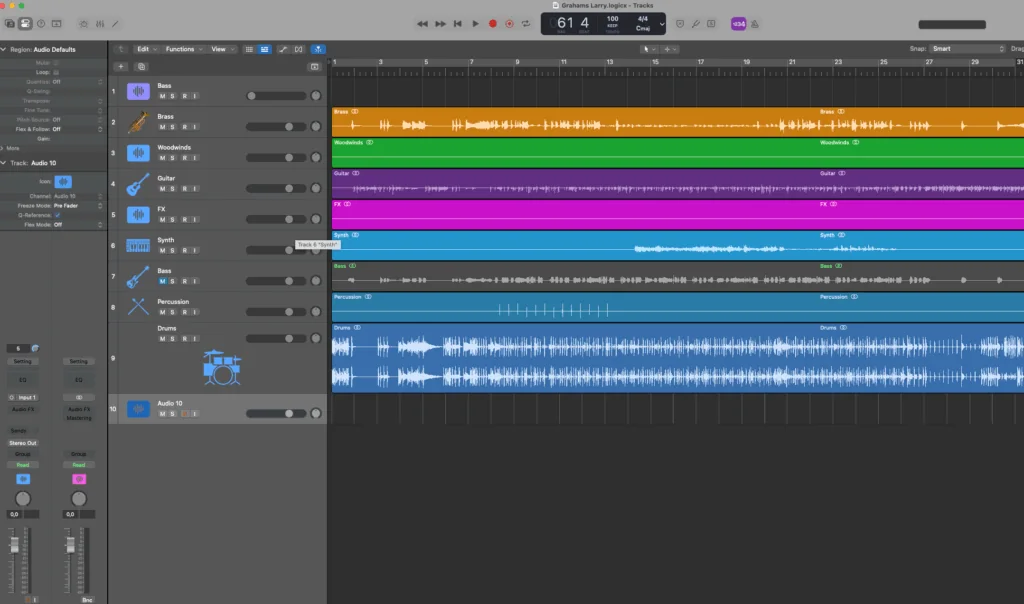
In my editor of choice, I then start re-recording tracks, for this example I’ll keep it short and simple, I just rerecord the bass track, cut weird elements out (Suno decided to put some random horn stabs into my track at odd moments, so I removed them).
My original idea is suddenly a lot closer to my intention, it's easier to arrange and record, I can share this with other musicians, producers or friends for feedback and collaboration and it is several steps closer to what I intended without costing me years of study and hours of production. It’s not ready to release, but it is a multi-instrument, rough recording that extends my creative reach and helps me get my ideas out into the world.
In a way, thanks to AI, I'm working as a music producer, defining and steering AI modelled musicians towards my vision. Or in the words of Sifu Rick Rubin:
I genuinely believe this “producer mode” is where the real added value of AI lies. AI, as a tool, creates an abstraction layer that frees us from needing to learn complex skills like orchestral composition just to write a simple disco string line.
The real power is in learning how to communicate with the technology effectively.
So let’s take this concept and generalize it to other uses of language models. Whether it’s programming or writing emails, learning how to talk to the machine is becoming a crucial skill.
What the machine see’s:
To be able to talk to a machine, you need to learn its language and have at least a basic understanding of how the technology works.
A few words in our human vocabulary look something like this to a language model:
[7, 1100, 6962, 70238, 873, 659, 8773, 42308, 230, 42300, 35795]
This process of turning words into numbers—and then calculating meaning and context—has evolved over time:
- 2013 – Word2Vec (Static Embeddings): One vector per word.
No sentence-level awareness, which creates a lot of problems with context. Each word has a vector, and the model interprets context word by word. - 2018 – BERT (Contextual Embeddings): Context is now defined by the sentence (bidirectional). This model is still widely used and offers much more control and nuance.
- 2020 – GPT-3: A transformer that predicts and generates the next token based on prior context, using positional encodings to produce fluent text (and code).
- 2025 – Agentic Frameworks: An emerging architectural paradigm which adds tools, resources, and structured responses into the mix. We’re off to the races.
Well almost. Language models can still mess things up. Most issues come down to context: the model matches the wrong vectors during runtime, which leads to hallucinations. (disclaimer: there are many more causes of this, but I'll skip them for the sake of saving words)
Without diving too deep into the technical details, here are a few basic guidelines to keep in mind:
- Reframe the paradigm: Don’t imagine an intelligent assistant. Think of AI as a very complicated cocktail shaker for data. There’s no “entity” here—it’s all statistics and modelling.
- When the model hallucinates: Shift your prompting strategy. Stop. Restart the process of prompting. Create clarity where required. Manage the input - carefully.
- Own the context: Managing and explaining context is your job. Let the AI generate unique data, but you’re the one steering it.
Context + Best practices:
- Your prompt…spend time writing it !!
- Use Delimiters. Text: """{text input here}""” or ###
- Relevant files and examples (screenshots work as well)
- The history of prompt output and inputs in the chat (so going back and forth and refining until you “zoom in” on the answer you need.
- Models like Claude loves compliments and coaching “Don't hold back. Give it your all.” (
The Claude models allow you to be extremely explicit with your prompts)
- Use positive constraints (“Do X, include Y, respect Z”) rather than “don’t”.
- With ChatGPT: Use bullet points and sub headers to organise your requirements (see how I structured my prompt for Suno into sections?)
- If you use Google Gemini tell it “Why” you want it to do something for you, It likes to understand intent up front.
- Use an LLM to write “power user prompts”. You can give an LLM an example of a really well thought out prompt and then have it follow that structure for new prompts.
- Don’t chat with the model, that’s not steering, give it outputs, roles, focus…
Structure your prompt using a prompt framework like (examples):
- RTF: Role- Task- Output Format
- TAG: Task- Action- Goal
- CARE: Context – Action – Result – Example
- FIRE: Focus – Input – Result – Evaluation
- Add an instructions file to your prompt as an attachment
- Use agents if you require an action, otherwise don’t, with short form tasks they go down rabbit holes. You can string together validated prompts in separate chats and get better results.
- There are many prompt generators online. Example: Sites like: https://promptboost.dev/instructions are great for developer prompts
Maybe you have heard of "Reasoning models". If you are using an LLM and it say's "thinking longer" or "reasoning" then thats what I am talking about (I have a blog post on thisread the linked source)
- Use them for inspiration on tough problems
- A Reasoning model creates multiple questions on its own and answers them, in separate branches, and then brings all those sub branches back together to answer your request
- Reasoning models often “overshoot” a request (don’t use them for simple stuff)
- All modern reasoning models have settings for how much reasoning they use (or how many “sub” questions and answers they generate). You can configure this before you fire the prompt off.
- Reasoning models work better without a huge amount of context up front (since they are already generating that themselves)
- Don’t vibe code or "chat" with a reasoning model
There is a lot to digest here. Thanks for reading, I hope you also have some form of "wow moment" trying out this technology and good luck talking with the machine.
Kai
Art is from the amazing: https://superrare.com/grif