
Over the last few weeks I’ve been busy experimenting with using AI coding tools (for everything except coding), studying Peter Haff’s concept of the “technosphere” and leaning into a new idea that’s been slowly forming in my head. The idea: The most pointless job at the moment is the “AI adoption lead”. Controversial statement right ? The idea isn’t born out of spite or some ill will that I bear towards consultants, nor am I riding the wave of the rebound against AI generated content. The reason I think it’s so pointless is simply because I believe AI is being positioned as a global technology and the challenge of “AI adoption” is not even in the ballpark of what is actually happening at the moment.
Back in 2020 when I was dipping my toes into generative AI, some hyperbolic futurists made bold claims like “AI is the new electricity”, which was a simple and catchy pivot from what they had already said in the 2010’s with “Data is the new oil”… it’s a great way of selling their services, and if I was a slightly more cynical human being, I’d simply leave it at that. However, in this case I think they were actually onto something. In fact I think that the people at the top, financing gargantuan data centres, building power plants to facilitate pre-training of neural networks, securing hundreds of billions in investments for data centres in space and printing money at shareholder meetings are also thinking about AI adoption in the same way.
So lets dig into this and see if I’m onto something. Is history repeating itself ? Will we be swept up in a moment that over the next hundred years (or so) reshapes our planet in the same way electricity has? If you have the patience and interest to follow me down this rabbit hole I’ll try and validate this idea with a bit of history, some numbers and (of course) some curly-logic.
Disclaimer: Since I’m trying to draw a line between the tectonic shift that electricity brought with it and my opening statement that AI adoption is pointless, I’ll skip the mathmatics of Maxwell, the compression concepts of Shannon or Turing’s architectures that birthed electricity, the internet and modern computing. I’ve tried studying that as well, but in this article I’m curious about what happened that moved the products of their genius out of the halls of universities, off the papers and into the daily lives of billions of people on our beautiful blue and green orb.
Spoiler: It wasn’t an adoption consultant.
Part 1, The lightbulb moment:
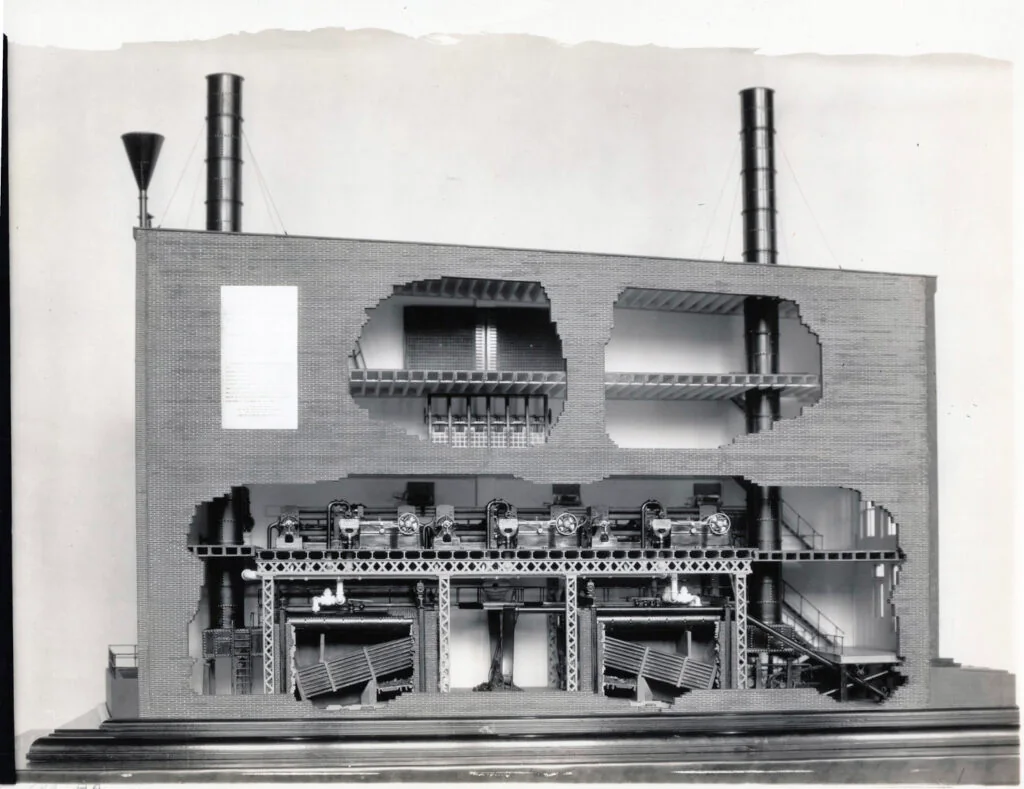
(A cutaway model of Edison's Pearl Street power station, showing boilers, engines, dynamos, and controls inside one early utility system. Image: Smithsonian National Museum of American History).
Electricity adoption started when Thomas Edison's Pearl Street station began operating on September 4, 1882, it wasn’t just a generator in a building. It was a complete system: coal-fired boilers, steam engines, six 27-ton "Jumbo" dynamos, underground copper conductors, fuses, meters, switches, lamps, customers, billing, permits, and a service area chosen for commercial density and publicity. It started in lower Manhattan and launched with roughly 85 customers using about 400 lamps; within a year, it had grown to 513 customers and about 10,000 lamps.
The first electric utility did not electrify America. It proved that a system could work and the adoption was deliberately targetted to go further than simply proving a scientific or engineering point. Edison chose a wealthy, dense, newsworthy part of New York: the financial district, close to newspapers, offices, and potential backers. J. Pierpont Morgan was among the investors whose offices were part of the launch moment. The most difficult problem was not simply making current. Low-voltage direct current could not economically travel far, and Pearl Street's underground conductors were costly. The project installed roughly 80,000 feet of underground conductors, and the distribution network was one of the most expensive parts of the system. POWER Magazine reports that the plant and distribution wires cost about $300,000 in 1882, before counting the operating costs of coal, labor, and maintenance. I won’t try and transform that number into more coherent numbers for someone reading this in 2026, but hopefully you see where I am going with this.
The same experiment was playing out internationally. London, Berlin, Milan, Barcelona, Buenos Aires, Shanghai, and many other cities became testing grounds for local utility concessions, foreign equipment makers, municipal systems, private franchises, and cross-border capital. Economic historians William Hausman, Mira Wilkins, and John Neufeld describe early electrification as a story of multinational enterprise and international finance, not only local invention. They note that from 1900 to roughly 1915/20, per-capita electricity production in the United States and most western European countries grew at annual rates of about 9% to 18%. That pace is extraordinary, but it was still concentrated. Electrification first followed density, industrial demand, municipal competence, and access to capital.
Access therefore became a global problem, not just a national one. Cities and prosperous business districts came first because density made the economics work. Farms, villages, colonies, and poorer regions waited because the last mile was expensive and because local incomes were too low to guarantee quick returns. The U.S. rural story is a useful case study of a wider infrastructure pattern. The Richmond Fed notes that by 1930 nearly nine in ten urban and nonfarm rural homes had electricity, but only about one in ten farms did. Private utilities argued that stringing lines over long rural distances would not pay for itself. Some estimated rural transmission could cost as much as $2,000 per mile, more than $30,000 in 2020 dollars. The gap was not caused by a lack of desire. Farmers knew electricity could power pumps, lights, milking machines, refrigeration, radios, and household appliances. The gap was caused by infrastructure economics.
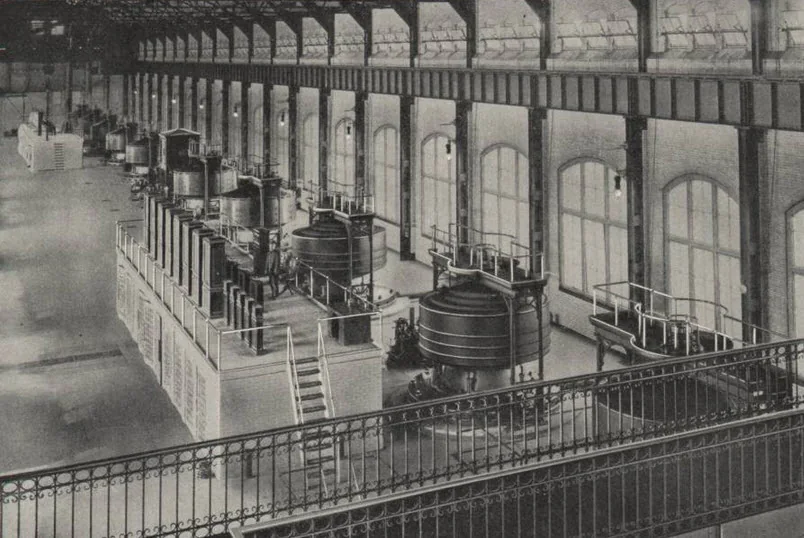
(Ten 5,000-horsepower Westinghouse generators at the Edward Dean Adams Power Plant, Niagara Falls, photographed in 1904. Image: Wikimedia Commons )
The U.S. response was institutional as much as technical. In 1935, Franklin D. Roosevelt created the Rural Electrification Administration, and Congress later set aside $100 million for loans to finance generation, transmission, home wiring, and appliances in rural areas. The REA leaned on cooperatives, not just investor-owned utilities. Engineers standardized materials and simplified rural line design, cutting average per-mile costs to less than $825 by the end of the 1930s The NBER history of the REA notes that only 3.2% of farms were electrified in 1925 and about 10% by 1930, but more than 90% had electricity by 1950. America's electric cooperatives similarly report that more than 90% of U.S. farms had electricity by 1953. Lewis and Severnini's study of the power-grid rollout summarizes the same transition as a move from less than 10% to nearly 100% over the three decades from 1930 to 1960. This movement required entire industries, sectors and groups of proffesionals to move with it, when something of this scale is moving, it takes decades not months.
The net effects (ba boom tish) were bigger than lights. Electricity changed how factories were organized. In older steam-powered plants, a central engine drove line shafts and belts. Machines had to be arranged around the shafting system, and when the engine failed, whole rooms stopped. Electric motors eventually allowed "unit drive": individual machines powered where they were needed. That meant cleaner layouts, better ventilation and lighting, overhead cranes, more flexible workflows, and continuous process improvement. NBER economists Andrew Atkeson and Patrick Kehoe emphasize that electricity was part of a 70-year transition after the Second Industrial Revolution, with several decades passing before measured productivity growth accelerated. They also note that plants had to be redesigned and managers had to learn how to use the new flexibility.
Finance was transformed early because finance is, at heart, an information business. The connection begins before universal household electricity, with the electric telegraph and stock ticker. EH.net's history of the U.S. telegraph industry says the telegraph consolidated financial and commodity markets and reduced information costs within and between firms. It gives a concrete example: in 1846, wheat and corn prices in Buffalo lagged New York by four days; after telegraphic connection in 1848, the markets could price simultaneously. The same logic hit securities markets. As price information traveled faster and more widely, New York became the country's central financial marketplace; by 1910, the New York Stock Exchange handled 90% of U.S. bond trades and two-thirds of stock trades.
The banking sector then became operationally electric. The Federal Reserve's large-value payment network, now Fedwire, began from a world of telegraph wires. Federal Reserve History explains that telegraph wires were the original communication mode for the Fed's large-value funds transfers and that the volume of messages led the Federal Reserve System to lease a dedicated telegraph system starting in 1918. That system later moved through teletype, relay equipment, automation, and computer networks. Money could move as messages, not only as paper or metal. That shift made banking faster, more centralized, and more liquid.
Electrification also changed finance because it was too capital-intensive for ordinary local banking to handle on its own. A University of Texas history of the electricity industry notes that larger power plants and networks required holding companies, multiple investors, and access to low-cost debt markets so generation, transmission, and distribution could be built and paid for over time. This was not only an American pattern. Hausman, Wilkins, and Neufeld show that in the 1890s and early 1900s, major German and Swiss electrical equipment manufacturers such as AEG, Siemens, and Brown Boveri helped organize financial holding companies to finance and manage electric utilities abroad; these structures drew on models developed for railway finance and linked equipment makers, banks, bond markets, and operating utilities across borders. The practical result was a new kind of infrastructure finance: risk was spread across banks, securities investors, manufacturers, holding companies, municipalities, and, eventually, national governments.
This financial architecture had consequences for banking and monetary integration. Electrified communication networks did not by themselves create monetary unions, but they made larger money and securities markets workable by shrinking information delays. The 1866 Atlantic telegraph cable is a clean example. A Journal of Economic History study of a security traded in both New York and London found that the information lag between the two markets shortened from about ten days to zero days after the cable opened, and the two markets became more closely integrated. The Italian monetary-unification literature is a useful caution: after Italy's 1862 currency union, prices of the same government bond across regional exchanges did not fully converge until 1887. The study finds that telegraph spread, trade, and the single currency were not enough on their own; nationwide market legislation was also needed. The point is broader than electricity: large networks require not only wires, but common rules, clearing systems, trusted intermediaries, and debt instruments deep enough to absorb enormous fixed costs.
At economy scale, electricity enabled longer working hours, new consumer appliances, refrigerated supply chains, electric rail and elevators, factory reorganization, mass entertainment, modern office work, and faster communication. But these effects arrived where capital, regulation, engineering capacity, and demand could line up and that was per country a different story. That is why electrification looks different in Britain, Germany, Japan, India, China, Brazil, and Nigeria. The physical technology mattered enormously, but so did who could finance it, who regulated it, who owned it, and who was left waiting for the network to reach them.
Electricity did not enter public life as a calm inevitability. In the late 1880s, overhead wires, accidental electrocutions, the electric chair, and the "war of the currents" produced a visible backlash. Harold P. Brown's 1888 newspaper letter "Death in the Wires" attacked alternating current and helped turn technical standards into public drama. Edison himself entered the argument with "The Dangers of Electric Lighting," warning that high-tension systems could become a "constant menace." Ask any electrician and they will tell you these fears were completely rational: early urban wiring really was chaotic and deadly. But the panic also became business theater, with rival companies using safety language to fight over standards and markets (Hi Anthropic).
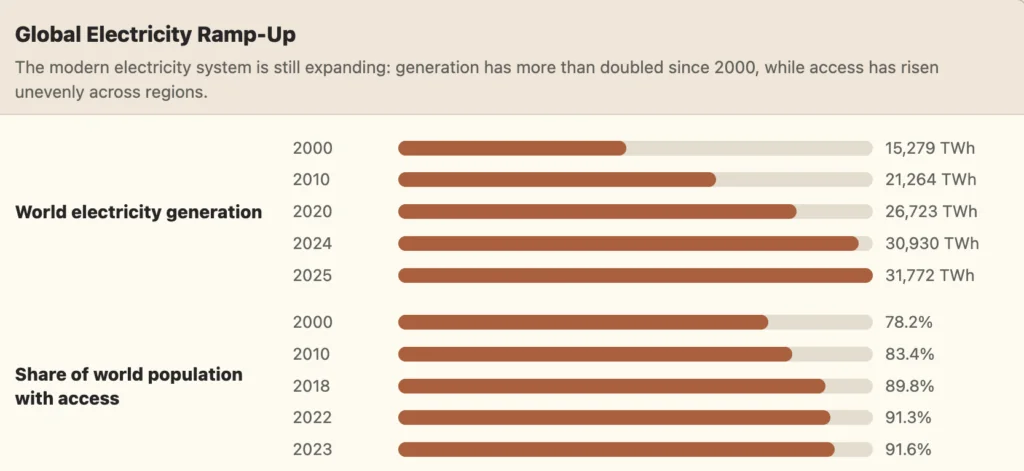
Electricity improved public health in many homes and workplaces by replacing some indoor flames, smoke, and manual drudgery. At the same time, the power system concentrated enormous combustion in central stations. The EIA says U.S. power plants burning fossil fuels or fossil-derived materials were the source of about 31% of total U.S. energy-related carbon dioxide emissions in 2022. EPA describes fossil fuel power plants as major sources of sulfur dioxide, nitrogen oxides, mercury, fine particles, and carbon dioxide. Regulation and cleaner generation later reduced some pollutants sharply: EPA reports that annual power-plant sulfur dioxide emissions fell 95% and nitrogen oxide emissions fell 89% from 1995 to 2023.
The broader lesson is that for electricity to become part of our day to day lives the world around it had to change, everything from laws and policies, to banks to factories and politics. You could even argue that a war or two had a major impact on the worlds shift towards turning on the lightbulb. But let’s not create a Gordian Knot out of this already overly long blog post and move onto the next society changing technology:
Part two: How the internet went global.
The internet followed the same pattern as electricity, but with network packages instead of current. It began as a small research network, became useful through standards and public funding, then spread through private carriers, fiber backbones, data centers, browsers, search engines, mobile networks, cloud platforms, app stores, payment rails, and undersea cables.
In 2026 loading this page on a phone is actually a planetary logistics system for information.
The internet's origin story is not a single invention moment. It is a sequence of design decisions about how computers should communicate. The ARPANET was built around packet switching: messages were broken into small pieces and routed through a network rather than carried over one dedicated circuit. The Internet Society's history notes that by the end of 1969, four host computers were connected to the initial ARPANET. ICANN marks October 29, 1969 as the date of the first ARPANET message, sent from UCLA to the Stanford Research Institute. That beginning was tiny, fragile, and expensive. It connected research institutions, not households. The value was in proving that different machines could share a network.
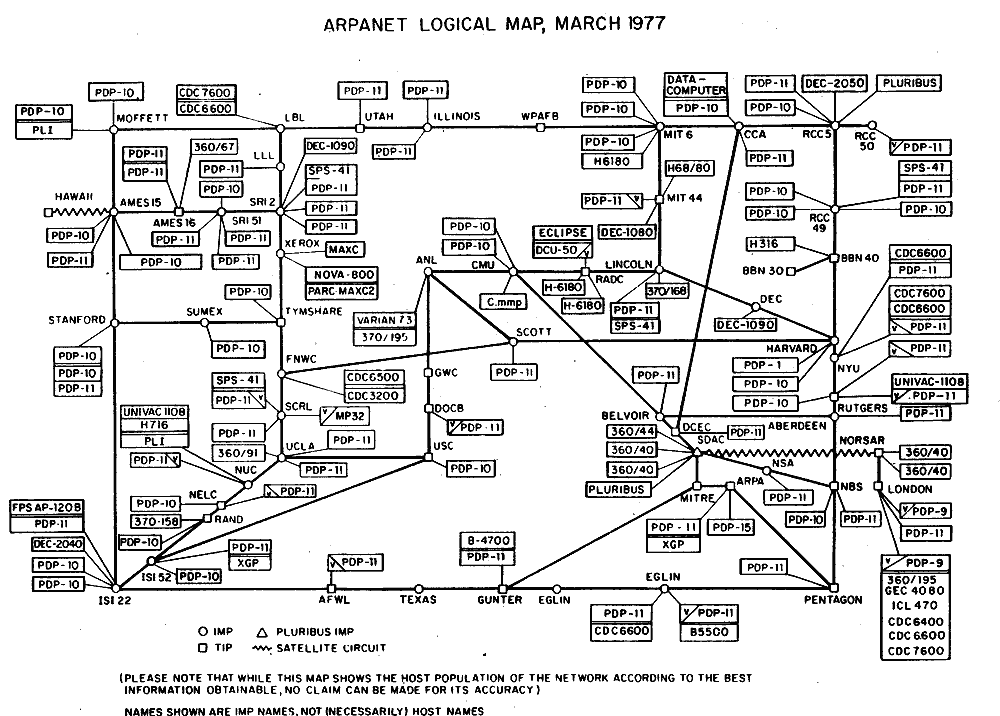
(The ARPANET logical map in March 1977 shows an early packet-switched research network before the commercial internet, web browsers, mobile broadband, and global submarine fiber made networking ordinary. Image: Wikimedia Common)
The deeper breakthrough came from open protocols. The internet did not become global because one company owned every wire. It became global because TCP/IP let different networks interconnect. The Internet Society describes this as the move from one network to an "open-architecture networking" system, where multiple independent networks could communicate through common protocols. On January 1, 1983, ARPANET's migration to TCP/IP became the symbolic birth date of the modern internet. This standard-setting work is less glamorous than the first message, but it is what allowed universities, governments, companies, and later households to join one interoperable system.
The World Wide Web then made the internet legible to ordinary people. Tim Berners-Lee invented the Web at CERN in 1989 to help researchers share information across institutions. The first website at info.cern.ch was a plain document explaining the Web project, but the combination of URLs, HTTP, HTML, browsers, and web servers gave the internet a human interface. Mosaic, Netscape, search engines, webmail, online retail, and social media then turned networking from an expert tool into a public medium.
Commercialization required another institutional shift. The NSFNET backbone, created in 1985 to connect U.S. researchers to supercomputing centers, became a crucial bridge from academic networking to commercial internet. Merit Network's history says the NSFNET grew from 217 connected networks in July 1988 to more than 50,000 by April 1995, when the backbone service was retired. The Internet Society calls the April 30, 1995 decommissioning of NSFNET a major milestone in the development of the commercial internet because private backbone providers and market forces took over more of the system. As with electricity, the transition from public experiment to commercial infrastructure was not automatic. It required standards, interconnection rules, pricing models, traffic exchange, and a business case for investment.
The current state of the internet is impressive and unfinished. ITU's 2025 Facts and Figures estimate that 6 billion people, about 74% of humanity, are online, up from 5.8 billion in 2024. But 2.2 billion people remain offline, most of them in low- and middle-income countries. The remaining gap is no longer only about whether a cable reaches a country. It is about electricity, devices, affordability, local-language content, gender norms, digital skills, reliable backhaul, cybersecurity, and whether people have enough income to use connectivity meaningfully. Like electricity, the internet can be technically present while still failing as a dependable service and again that’s something that takes decades to achieve.
The physical network is still expanding. TeleGeography says that as of 2026 it tracks more than 600 active and planned submarine cables. Its 2026 submarine cable map depicts 694 in-service and planned systems and 1,893 landing stations. A separate TeleGeography investment update says the value of new submarine cables planned to enter service from 2026 to 2029 exceeds $16 billion, with particularly large planned spending across Asian and trans-Pacific routes. These cables carry the invisible commerce of the modern world: cloud traffic, video calls, software updates, social media, remittances, card payments, securities trades, and government communications. A cut cable can still isolate islands, slow economies, or raise geopolitical alarms. The internet may be decentralized in protocol, but it is quite physical in its chokepoints. The recent valuation of SpaceX is tied to this shift and the foundational infrastructure for global technology.
Just like electricity, finance changed again because the internet made information and payments interactive. Electrified telegraphy and Fedwire had already turned money into messages for institutions. The internet extended that logic to households, merchants, gig workers, migrants, and small firms. Online banking, card-not-present commerce, mobile wallets, peer-to-peer payment apps, open banking APIs, electronic exchanges, and app-based lending all depend on networks that can identify users, move data, settle claims, and detect fraud in near real time. The World Bank's Global Findex 2025 reports that 79% of adults globally now have an account, up from 51% in 2011, and describes how mobile money and digitally enabled accounts are transforming financial behavior. Visa's summary of the same report notes that in low- and middle-income economies, 61% of adults made or received a digital payment in 2024, and 42% of adults worldwide made a digital merchant payment.
The internet also changed the shape of firms and markets. A small business could sell through a platform, a software company could serve customers globally from cloud infrastructure, a bank could reduce branches while increasing digital services, and a trader could respond to prices in milliseconds. I’ve intentionally left the role of the “man in the middle” out of this, but I highly recommend reading “Techno-Feudalism” for the actual economics of the cloud. But the same network logic concentrated power in platform companies, payment processors, cloud providers, app stores, ad exchanges, identity systems, and cybersecurity vendors. The internet reduced some barriers to entry while creating new gatekeepers. Its financial history therefore resembles electricity's: lower unit costs and broader access came with larger networks, greater standardization, and institutions powerful enough to finance and govern shared infrastructure.
The internet's mass rollout produced skepticism and moral panic at the same time. In 1995, Clifford Stoll's Newsweek essay, later remembered by its headline "The Internet? Bah!," dismissed many online-utopian predictions with the one-word verdict "Baloney." That same year, TIME's "Cyber Porn" cover crystallized fears that the network would bring dangerous material into homes and schools. Privacy anxiety rose as cookies, online profiles, email, and web tracking made people realize that the new public square was also a surveillance and marketing system; a 1997 Wired report summarized a poll in which more than half of users expressed concern about email and web activity being monitored. It’s taken decades for governments to catch up to the internet with legislation and laws, and even in the 2020’s there are a ridiculous number of examples of politicians asking tech monopolists ridiculous and archaic questions.
The internet replaced some physical travel, paper, and inventory, but it also created energy demand in networks, data centers, devices, and manufacturing. The IEA estimates that global data transmission networks consumed 260-360 TWh of electricity in 2022, or about 1-1.5% of global electricity use, with mobile networks accounting for about two-thirds of network energy consumption. Estimates for the broader ICT sector vary, but a World Bank review notes that studies place ICT's share of global carbon emissions in a range from 1.5% to 4%. The footprint is calculated not only electricity. Phones, routers, servers, batteries, screens, and fiber equipment require metals, plastics, chemicals, assembly labor, repair systems, and waste management. The internet made knowledge feel weightless; the network itself is not.
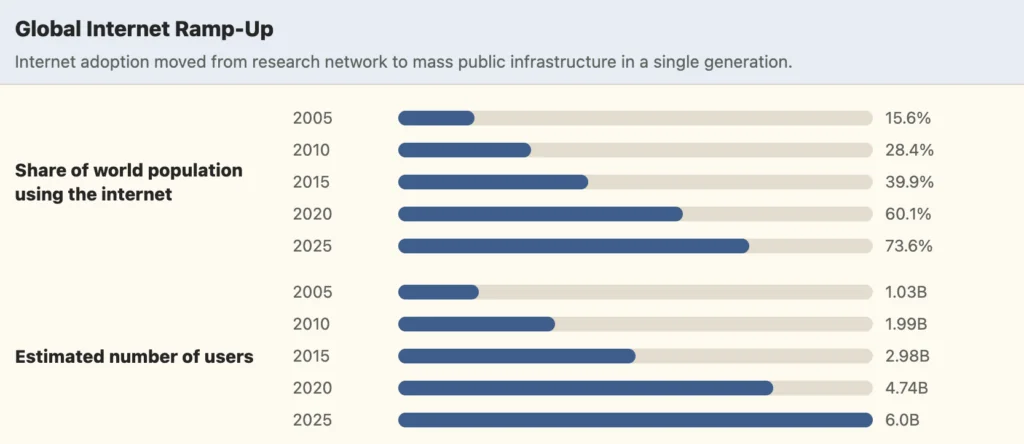
The second global technology in this rabbit hole was communication and conncection, the pattern is hopefully forming in your mind as well, it takes decades to get us to the point where you can click on a link, open a page and then share it with your friends (yes, this is a poorly disguised “like and subscribe” interlude).
Part Three, The AI Boom:
Okay, lets bring it home now and get to the point that I’m trying to make. Like electricity and the internet, AI first appears in the halls of universities and research departments of defence departments. For it to become a global technology though the boom has to be one of infrastructure. Training and running frontier systems requires specialised processors, high-bandwidth memory, networking, storage, backup systems, cooling, fiber links, software orchestration, and huge buildings designed to keep dense racks of machines online. The public sees a prompt box. The investment world sees chips, power contracts, land, transformers, water, and multi-decade capital commitments.
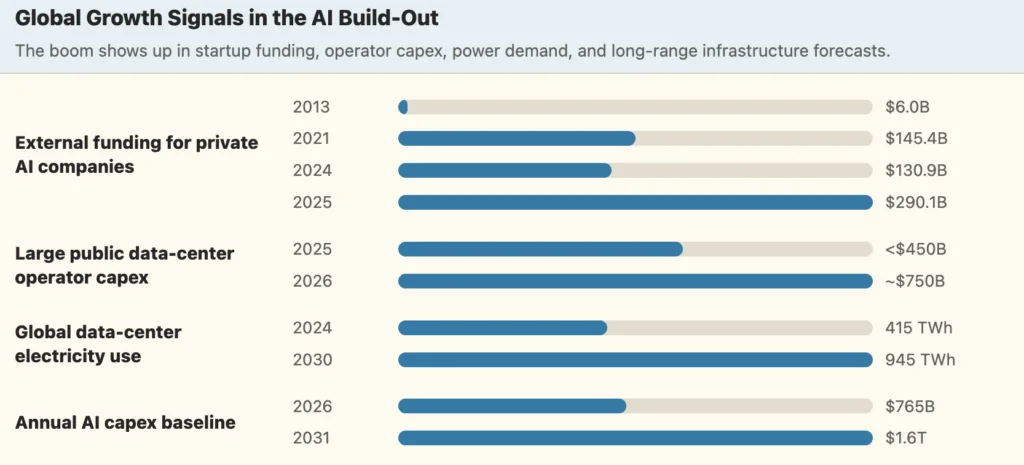
The investment numbers are already staggering at global scale. Stanford HAI's 2026 AI Index reports that global corporate AI investment reached $581.7 billion in 2025, up about 130% from the prior year, while private investment alone reached $344.7 billion. The geography is uneven but not simple. The United States led tracked private investment with $285.9 billion in 2025, more than 23 times China's $12.4 billion, but Stanford cautions that private-investment figures likely understate China's total AI spending because government guidance funds deployed an estimated $184 billion into AI firms from 2000 to 2023. Our World in Data's AI Index-derived startup dataset shows 3,499 newly funded AI companies worldwide in 2025: 1,953 in the United States, 639 in Europe, and 161 in China. The boom is global, but the commanding heights of capital, chips, models, and data-center hosting remain concentrated.
If you think that these people are investing in a chatbot that is good at completing homework, or writing code, then you need to take a long hard look in the mirror, these investments are being made to reshape our society, economy and our person.
Data-center capital spending gives a clearer sense of physical scale. BloombergNEF reported in March 2026 that the capital expenditure of the 14 largest publicly owned data-center operators globally was expected to approach $750 billion in 2026, up from a little under $450 billion in 2025. It also estimated that 23.1 gigawatts of data-center IT capacity was under construction globally at the end of September 2025, spread across 831 sites, with the United States alone hosting 15.9 gigawatts. Those figures point to concrete, steel, substations, transformers, switchgear, high-voltage interconnects, construction crews, and years of permitting.
The build-out is also global in its dependencies. Stanford HAI notes that the United States hosts 5,427 data centers, more than ten times any other country, while the leading AI chip supply chain depends heavily on TSMC in Taiwan. Europe is trying to expand shared compute through AI factories and gigafactories, Gulf states are using energy and sovereign wealth to attract AI infrastructure, and Asian manufacturing networks remain central to chips, memory, power equipment, and servers. In other words, AI may be branded by a few model labs, but its physical economy is international.
Consultants and banks are trying to model how large the investment wave could become. McKinsey estimated in 2025 that data centers worldwide would need about $6.7 trillion in capital by 2030 to keep up with compute demand, including $5.2 trillion for AI-capable data centers. Its scenarios ranged from $3.7 trillion in a constrained case to $7.9 trillion in an accelerated case. Goldman Sachs, looking from 2026 onward, estimated roughly $7.6 trillion in cumulative AI capital expenditure between 2026 and 2031 across compute, data centers, and power, with annual AI capex rising from $765 billion in 2026 to $1.6 trillion in 2031 under its baseline assumptions. The exact totals differ because each analysis draws the boundary around AI infrastructure differently. The shared conclusion is that AI is becoming one of the largest private infrastructure races in modern economic history and that includes
OpenAI's Stargate program is a useful example because it makes the physicality plain. In September 2025, OpenAI said that five new U.S. AI data-center sites, combined with its Abilene, Texas flagship site and CoreWeave projects, brought Stargate to nearly 7 gigawatts of planned capacity and more than $400 billion in investment over the next three years. OpenAI described this as a path toward a $500 billion, 10-gigawatt commitment, and said it had reviewed more than 300 proposals from more than 30 states. That language belongs to infrastructure: site selection, power availability, tax negotiation, construction labor, supply-chain risk, and local bargaining over land and water.
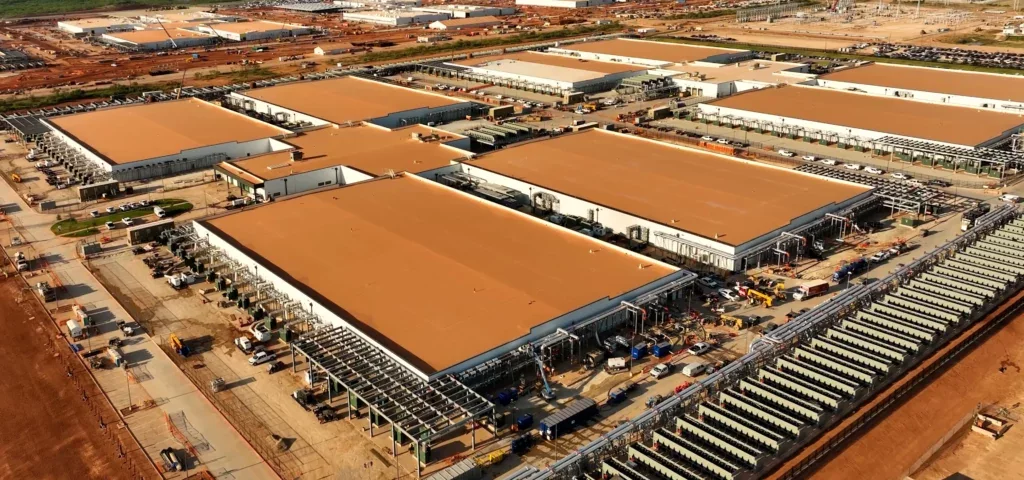
(OpenAI's Abilene data centers, part of the Stargate infrastructure program. The AI economy's "cloud" is built from land, power equipment, cooling, roads, and long-term financing. Image: OpenAI)
Power demand is the bottleneck that turns AI from a software story into an energy story. The International Energy Agency estimates that data centers consumed around 415 terawatt-hours in 2024, about 1.5% of global electricity use, and projects that number will more than double to around 945 terawatt-hours by 2030 in its base case. The IEA also expects data-center electricity consumption to grow about 15% per year from 2024 to 2030, more than four times faster than growth in electricity consumption from all other sectors. Accelerated servers, mainly driven by AI adoption, are projected to grow 30% annually in electricity consumption and account for almost half of the net increase in global data-center electricity use.
As with the initial years of electricity and internet adoption the geography of AI is sharply uneven. The IEA projects that the United States and China will account for nearly 80% of global data-center electricity-consumption growth to 2030. Goldman Sachs Research separately forecast that U.S. data-center power demand could rise from 31 gigawatts in 2025 to 41 gigawatts in 2026 and 66 gigawatts in 2027, assuming scheduled capacity comes online. Some regions can absorb new load; others face transmission constraints, generation shortages, water concerns, or local opposition. The AI economy is therefore a map of substations, interconnection queues, local politics, and power-market rules.
AI's public backlash has moved faster than the technology's physical build-out. In March 2023, the Future of Life Institute's open letter asked whether society should risk "loss of control of our civilization" and called for a pause on training more powerful frontier systems. Two months later, the Center for AI Safety released a one-sentence statement warning about the "risk of extinction from AI," signed by prominent researchers and executives. Labor resistance arrived just as quickly: the Writers Guild of America says its 2023 contract established "groundbreaking AI protections" for writers. Public opinion remains wary too. Pew's 2025 survey found that 50% of U.S. adults were more concerned than excited about AI in daily life, while only 10% were more excited than concerned.
The environmental burden of AI is evident and can be explained by the breakneck speed it is moving at. The calculation of impact obviously depends heavily on where data centers are built, what electricity they buy, and how they are cooled. A June 2026 UNU-INWEH report argues that AI's environmental costs should be measured across carbon, water, and land footprints, not carbon alone. The IEA's base case would lift global data-center electricity use from 415 TWh in 2024 to 945 TWh by 2030. Water is also material: EESI reports that a medium-sized data center can consume up to roughly 110 million gallons of water per year for cooling, while some large facilities can use up to 5 million gallons per day. Better chips, heat reuse, cleaner power, dry cooling, and flexible operation can reduce impacts, but they do not remove the core public question: who receives the benefits, and which communities absorb the energy, water, land, and grid costs?
The latest SpaceX news shows how far the infrastructure search is moving. On February 4, 2026, the FCC Space Bureau accepted for filing SpaceX's application for a new non-geostationary orbit system of up to one million satellites, described as the "SpaceX Orbital Data Center system." The notice says the satellites would operate between 500 and 2,000 kilometers in altitude and use high-bandwidth optical inter-satellite links. That is not approval to build a million satellites tomorrow. It is, however, a serious regulatory marker that the AI data-center race is reaching beyond Earth-based land and grid constraints.
In reporting checked for this article on June 12, 2026, Space.com reported on June 11 that Elon Musk had outlined more details for SpaceX's planned AI satellites. Musk described satellites with solar cells, radiators, high-speed optical links, and "racks of compute" that could connect to other satellites and to Starlink. Space.com reported that each AI satellite would generate about 150 kilowatts at peak and 120 kilowatts consistently, launching on Super Heavy and Starship vehicles. Light Reading, summarizing the same technical update, reported that SpaceX's AI1 design was described as roughly 20 meters high with a 70-meter wingspan, using radiators to shed heat into space and optical links for connectivity.
SpaceX is not alone in exploring orbital compute. Google Research's Project Suncatcher, announced in November 2025, studies solar-powered satellite constellations carrying TPUs and connected by free-space optical links. Google argues that in the right orbit, a solar panel can be up to eight times more productive than on Earth and can produce power nearly continuously, reducing battery needs. Its early analysis suggests that if launch prices fall below $200 per kilogram by the mid-2030s, the cost of launching and operating a space-based data center could become roughly comparable to reported energy costs for an equivalent terrestrial data center on a per-kilowatt-year basis. Google also says it plans an early learning mission with two prototype satellites by early 2027.
Part four, the patterns and getting to the point:
Electricity, the internet, and AI are different technologies of course, but in my mind they sing in harmonised chore as global infrastructure revolutions. Each began as a technical breakthrough, then became socially transformative only when networks, standards, finance, institutions, and everyday habits formed around it and none of that happened overnight. Let’s break down the patterns and (hopefully) get to the point.
The first pattern is general-purpose usefulness. Electricity could light streets, run motors, power elevators, enable radio, refrigerate food, pump water, and reorganize factories. The internet could carry mail, documents, news, payments, search, markets, software, social life, education, and media. AI can write, summarize, translate, code, detect patterns, generate images, assist research, operate robots, and coordinate business processes. In each case, the first visible use was only a hint. The deeper transformation came when other industries rebuilt their own routines around the new capability.
The second pattern is hidden build-out. The lamp hid dynamos, copper, substations, meters, tariffs, and coal. The web page hid packet switching, TCP/IP, fiber, routers, DNS, data centers, IXPs, submarine cables, and browsers. The AI assistant hides accelerators, memory, cooling, cloud contracts, grid connections, chip foundries, training data, and power markets. The public interface gets simpler as the supporting system gets larger.
The third pattern is finance. Electric utilities needed bonds, holding companies, municipal finance, public loans, and regulated returns. The internet needed public research funding, telecom capital, fiber overbuild, venture capital, advertising markets, platform economics, and cloud capex. AI is creating its own financial structures: hyperscaler capex, neocloud leasing, long-term compute contracts, power-purchase agreements, chip prepayments, sovereign AI funds, and partnerships among model labs, cloud companies, semiconductor firms, and energy providers. BloombergNEF's note that hyperscalers signed leases with neocloud companies potentially worth more than $100 billion over six months, and that number is considered normal in 2026 (!)
The fourth pattern is the productivity lag. Electricity's biggest gains required reorganizing factories. The internet's biggest gains required reorganizing supply chains, media, retail, banking, software, and communication. AI may be similar. Adding a chatbot to an old workflow is like putting a website on top of a paper process or an electric motor into a steam-era factory without changing the layout. The larger gains may require redesigning how documents move, how decisions are reviewed, how software is built, how compliance works, how customer issues are triaged, how research is conducted, and how employees are trained and that takes decades of work, not from the AI consultant, but from the entire organisation.
The fifth pattern is regulation and trust. Electricity had to solve safety, reliability, monopoly pricing, public rights-of-way, and service obligations. The internet had to solve interconnection, domain governance, spam, cybersecurity, content moderation, privacy, competition, and resilience. AI must solve model reliability, data privacy, cybersecurity, copyright, labor disruption, misinformation, safety testing, market concentration, and energy impacts. Infrastructure becomes legitimate only when people can understand its costs, trust its reliability, and see a path to broad benefit.
Again, just to be clear: I’ve got nothing against adoption consultants, I just don’t think the conversation should (exclusively) be about artificial general intelligence, hallucinations or about the latest models and benchmarks, when the people steering this technology are taking very real and tangible steps to change our world with this global technology.
Thanks for reading,
Kai
Sources:
- IEEE Engineering and Technology History Wiki, "Pearl Street Station, 1882."
- Federal Reserve Bank of Richmond, "Electrifying Rural America."
- POWER Magazine, "The Edison of 1879."
- Atkeson and Kehoe, NBER Working Paper 8676, "The Transition to a New Economy After the Second Industrial Revolution."
- EH.net, "History of the U.S. Telegraph Industry."
- Federal Reserve History, "Fedwire."
- University of Texas Energy Institute, "The History and Evolution of the U.S. Electricity Industry."
- Wikimedia Commons / Library of Congress, "Westinghouse Generators at Niagara Falls."
- Stanford HAI, "2026 AI Index Report."
- International Energy Agency, "Energy demand from AI."
- BloombergNEF, "AI Data Center Build Advances at Full Speed."
- Goldman Sachs, "Tracking Trillions: The Assumptions Shaping the Scale of the AI Build-Out."
- McKinsey, "The cost of compute: A $7 trillion race to scale data centers."
- OpenAI, "OpenAI, Oracle, and SoftBank expand Stargate with five new AI data center sites."
- Federal Communications Commission, DA 26-113, SpaceX application for orbital data centers.
- Space.com, June 11, 2026, "Elon Musk wants to put 1 million AI satellites in space."
- Marcus by Goldman Sachs, June 1, 2026, "What Is the Forecast for US Data Center Power Demand?"
- Light Reading, June 10, 2026, "Musk: 'Magic' not needed for SpaceX's orbital AI data center plan."
- Google Research, "Exploring a space-based, scalable AI infrastructure system design."
- Smithsonian National Museum of American History, "Model of Edison's Pearl Street power station."
- U.S. Energy Information Administration, "Electricity and the environment."
- U.S. Environmental Protection Agency, "Human Health & Environmental Impacts of the Electric Power Sector."
- America's Electric Cooperatives / NRECA, "History."
- Joshua Lewis and Edson Severnini, "Short- and Long-Run Impacts of Rural Electrification."
- Stanford HAI, 2026 AI Index Report, "Economy."
- United Nations University INWEH, "The Environmental Cost of Artificial Intelligence: Carbon, Water, and Land Footprints."
- Environmental and Energy Study Institute, "Data Centers and Water Consumption."
- NBER Working Paper 19743, "The Spatial Impact of the Rural Electrification Administration 1935-1940."
- U.S. Environmental Protection Agency, "Progress Report: Emissions Reductions."
- Hausman, Wilkins, and Neufeld, "Global Electrification: Multinational Enterprise and International Finance in the History of Light and Power, 1880s-1914."
- Our World in Data, "Electricity generation," based on Ember yearly electricity data.
- International Energy Agency, "Access to electricity - SDG7: Data and Projections."
- Tracking SDG7 / World Bank, "Chapter 1: Access to Electricity," 2025 Energy Progress Report.
- Our World in Data, "Share of the population with access to electricity," based on World Bank World Development Indicators.
- Garbade and Silber, "The Atlantic Telegraph Cable and Capital Market Information Flows," Journal of Economic History.
- Toniolo, Conte, and Vecchi, "Monetary Union, institutions and financial market integration: Italy, 1862-1905."
- Our World in Data, "External funding for privately held AI companies," based on Quid via the AI Index Report.
- Our World in Data, "Newly-funded artificial intelligence companies," based on Quid via the AI Index Report.
- Internet Society, "A Brief History of the Internet."
- CERN, "A short history of the Web."
- CERN, info.cern.ch, home of the first website.
- International Telecommunication Union, "Facts and Figures 2025: Internet use."
- Merit Network, "The NSFNET Backbone Service."
- Internet Society, "Happy Birthday, Backbone."
- TeleGeography, "Building Tomorrow's Internet: A 2026 Update on Cable Investment."
- Our World in Data, "Share of the population using the Internet."
- Our World in Data, "Number of people using the Internet."
- TeleGeography, "Submarine Cable FAQs."
- ICANN, "The First Message Transmission."
- TeleGeography, "2026 Submarine Cable Map."
- Wikimedia Commons, "Arpanet logical map, March 1977."
- World Bank, "The Global Findex Database 2025."
- Visa Economic Empowerment Institute, summary of World Bank Global Findex 2025 findings.
- International Energy Agency, "Data Centres and Data Transmission Networks."
- World Bank, "Measuring the Emissions and Energy Footprint of the ICT Sector."
- University of Leicester, "Research finds Earth's technosphere now weighs 30 trillion tons."
- UN Environment Programme, "Global Resources Outlook 2024."
- Global E-waste Monitor 2024.
- Peter K. Haff, "Technology as a geological phenomenon: implications for human well-being."
- Earth System Dynamics, "Delineating the technosphere: definition, categorization, and interactions with the Earth system."
- Elhacham et al., Nature, "Global human-made mass exceeds all living biomass."
- Journal of Industrial Ecology, "Global material flows and resource productivity: The 2024 update."
- UN Environment Programme, "Rich countries use six times more resources, generate 10 times the climate impacts."
- World Health Organization, "Electronic waste (e-waste)."
- Invention & Technology Magazine, "Inventing Electrocution."
- Thomas A. Edison, "The Dangers of Electric Lighting," North American Review, hosted by Tesla Universe.
- Clifford Stoll, Newsweek, "Why the Web Won't Be Nirvana."
- TIME Magazine, "Cyber Porn," July 3, 1995 cover.
- MIT OpenCourseWare, "The Internet Censorship Saga: 1994-1997."
- Wired, "Poll: Many Fear, Few Fall Prey to Online Privacy Attacks."
- Future of Life Institute, "Pause Giant AI Experiments: An Open Letter."
- Center for AI Safety, "AI Extinction Statement" press release.
- Pew Research Center, "How Americans View AI and Its Impact on People and Society."
- Writers Guild of America West, "Artificial Intelligence."