
Every year on April 22nd we celebrate world earth day. A moment of appreciation for the amazing planet we live on, kind of cool right ? Well sort of, this year it became a day of introspection, insight and critical analysis of artificial intelligence and its role, both positive and negative, in our planet’s and humanities future.
Just a quick disclaimer: Yes, I work in tech and have done so for my whole adult life, but I’m also a bit of a hippy when it comes to nature (specifically forests). My childhood in Australia was interwoven with a raw natural beauty that is almost impossible to fully express in words. So I’ll make an attempt here in this humble blog post to map my knowledge of artificial intelligence, my gig at Kerkrade speaking at the Discovery Museum and my love of this big blue orb.
So lets start with the problem statement, and its a big one: Extinction. As professor of Palaeontology Leon Claessens presented at the evening, with his dodo skeleton, when species are wiped out, its impossible to turn back the clock. So this isn't a problem to put in a sprint backlog and make a minimum viable product out of.
I subscribe to the school of thought that we are products of a deeply connected and fundamentally misunderstood system. Kort van Mensvoert (CEO of Next Nature Museum in Eindhoven) laid this out much more competently than I could hope for, with his presentation of the Geosphere, BioSphere and Technosphere. Following his logic: Complex life is supported and spawned at a microbial level deep within the earth’s crust and everything from our amazing brains to our communications systems, to our not so amazing flaws are just as much a part of this organism-planet as a tree, plastic bottle, microscopic plankton or a smartphone. Thanks to a combination of modern technology and our wonderous brains, we can almost grasp the connection; however we are fundamentally limited by the simple fact that we are an integral part of the system. The unfortunate truth of the human condition is that the more we understand and discover, the more complex our reality becomes. The simplest, and most complicated example of this paradox: Quantum mechanics. We simply aren’t built to understand them, they fundamentally don’t make sense to us (or me, specifically). Sure we can make the connection between an apple falling on our heads or energy being created or lost, but if we really want to understand our reality in a rational sense, then it turns out that we have to move into a realm that is completely alien to our monkey brains. We just aren’t built for this kind of stuff, and yet we are building quantum computers and solving these mysteries at an every increasing pace. So how did we overcome our intrensic limitations?
The same way we have been doing for thousands of years, with tools. Our ability to create tools has, in my humble opinion, reached its zenith with artificial intelligence. My question is not the one that Ray Kurzweil's singularity asks, where a machine surpasses a human. Mine is: What will happen to us at a societal level when our tools augment our interactions with our surroundings to a level that surpasses nature and nurture? More importantly and more relevantly to world earth day, what is the cost of this massive leap forward and is gambling our planet (you know that big rock in space that we kind of rely upon completely to even exist) worth the pay off?
At the world earth day event there were many speakers and each one seemed more inspirational than the last. One in particular asked a profound question: professor Felienne Hermans posed an emotional and philosophical question to the audience: Picture a place of significance, a small part of the world that we feel connected to, and now imagine that it is gone forever. For me this was that place and I pictured it in precise detail the moment she asked the question.

This simple rock in the forest was my place of safety as a kid, I’d go out at night or day to the Darling Ranges of West Australia and following a meandering narrow footpath down into the valley I’d climb up this huge granite boulder and look out over the ranges under the full moon, or in the glaring hot summer sun and just connect with my environment. The problems of a teenager felt small compared to the vista in front of me, and when nothing in life was certain the granite boulder was like a rock in a river bed, gently unmoving and massive in its embrace of this small short lived organism, as he contemplated life the universe and everything. When I move into another state of matter, my ashes will be here and the concept of this place being taken from me is as abhorrent as it is tragic.
So lets ask that question again and again: Is developing the ultimate tool worth the price tag? This is a rhetorical question with a simple answer, but its a question that everyone who works in AI should be asking themselves.
And we know how to do it, because we have been here before:
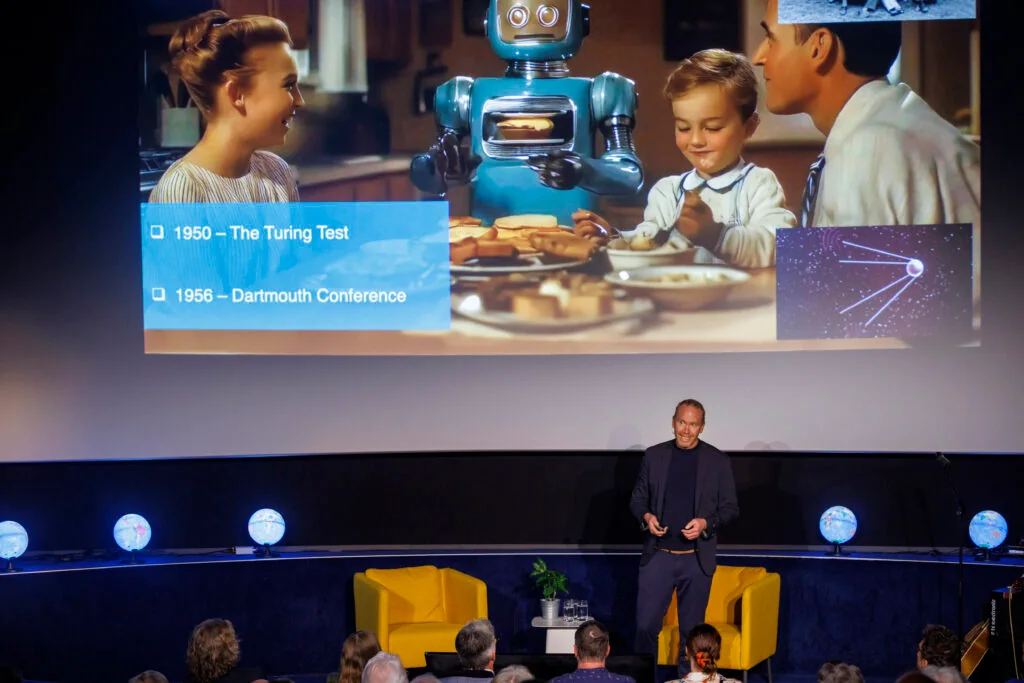
From its humble beginnings in the philosophical question of Alan Turing in 1950 “Can a machine think ?” This question was not structured in terms of scalability or ecology, it’s a hypothetical from a cryptographic genius. The 1943 grandfather model, the McCulloch-Pitts neuron model had been around for years before Turing drafted his paper, but even the people who thought it up considered it too inefficient for actual use. The zeitgeist of the 50s was less pessemistic though: This was the age of techno-optimism. The problem with this technology and its underlying models were seen as something that could be overcome through sheer force of will, in much the same way the world war had been won. In 1956 at the Dartmouth conference the godfathers of modern computer science stated that if we could take the processes of the brain and structure and map them out logically then we could model them, the hop skip and a jump was made from a dream to a fantasy to a reality. Science fiction writers loved the idea, and while families gazed at televisions in their living rooms for the first time, and watched reports of a Russian satellite in space, they collectively extrapolated this into killer robots, starships, moon bases and alien warlords.
The catch was that in the 1970’s it all fell apart, Minsky & Papert’s 1969 book “Perceptrons” hammered nails into the coffin of artificial intelligence for the simple reason that there just wasn’t enough computing power on the planet to support scaling these systems. The wild promises and overly ambitious military projects of the cold war collapsed like a house of cards and funding moved to the much more fertile grounds of home computing. The AI Winter parts I + II had begun and it wouldn’t be until the zero’s that the neurons struck back.
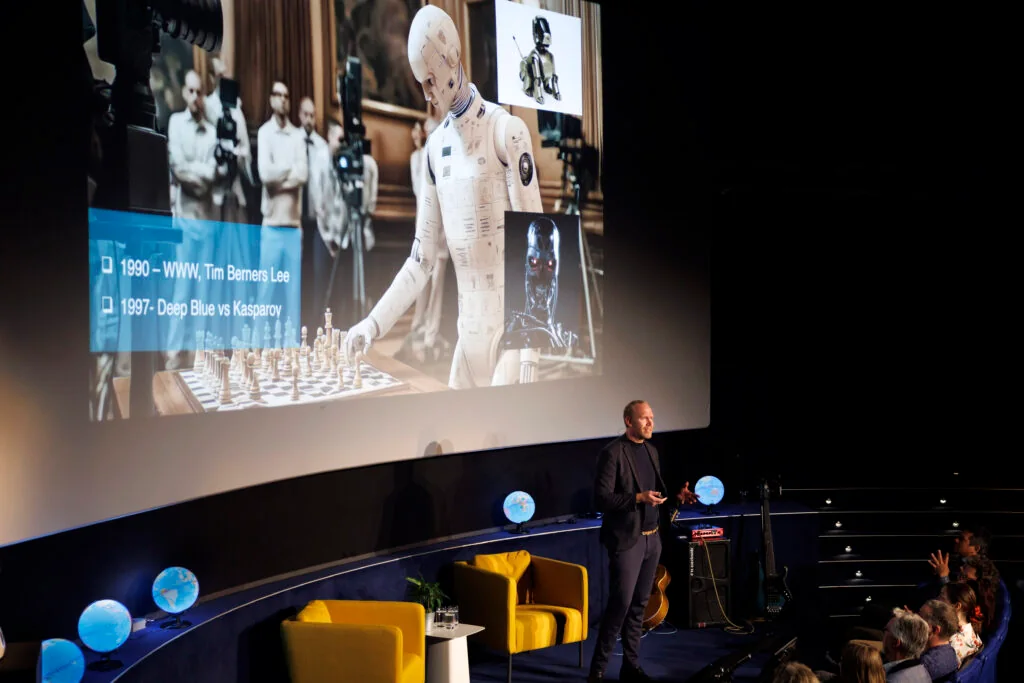
Obviously this wasn’t the end of the story, but it almost was. In the background, niche research continued and slowly but surely the neural network was born, the inklings of deep learning and language models also started to appear and AI was saved by two unlikely allies: Computer games and the bursting of the Dotcom bubble.
At the end of the 90s dedicated graphics processors became a thing, and it turned out that they could do a lot more than one thing
Interesting interview about CUDA here to illustrate this point:
And when the dotcom bubble burst all those overvalued tech companies desperately started harvesting user data in a scramble to stay alive. Suddenly universities had affordable processors and massive datasets, together with deep learning there was a convergence of concepts that, in a slow burn decade of the 2010’s lead up to the complete explosion of AI that we see today. There’s a catch though. The Papert- Minsky book was still spot on, you need a ridiculous amount of compute to make these systems viable. Compute = energy. How much...well buckle up because it aint good.
Here’s some depressing soundbites and links to give you an idea of where we are at the moment:
(yes I used OpenAI Deep Research for this, and yes I pruned the results)
- Data centers running AI workloads already consume as much electricity as some mid-sized countries (How on-device AI could help us to cut AI's energy demand | World Economic Forum).
- Globally, data centers (which host most AI processing) account for roughly 1–2% of electricity consumption as of the early 2020s (AI has high data center energy costs — but there are solutions | MIT Sloan). This share is comparable to the aviation industry’s energy use and associated emissions (AI has high data center energy costs — but there are solutions | MIT Sloan). In absolute terms, data centers consumed an estimated 460 terawatt-hours (TWh) in 2022 and were on track to exceed 500 TWh by 2025, about 2% of worldwide electricity (Data center sustainability | Deloitte insights). The International Energy Agency (IEA) projected that global data center electricity demand could double between 2022 and 2026, fueled in part by AI adoption (AI has high data center energy costs — but there are solutions | MIT Sloan). In other words, by mid-decade data centers may draw on the order of ~3–4% of global power – roughly equivalent to the consumption of a country like Japan (Electricity 2024 - Analysis and forecast to 2026).
- In 2022, data centers and crypto mining combined emitted nearly 1% of global CO₂ (about 0.5% from data centers alone) (Carbon Emissions from AI and Crypto Are Surging and Tax Policy Can Help) (Carbon Emissions from AI and Crypto Are Surging and Tax Policy Can Help). If trends continue, their emissions could reach 450 million metric tons CO₂ by 2027 (≈1.2% of world emissions) (Carbon Emissions from AI and Crypto Are Surging and Tax Policy Can Help).
- Training OpenAI’s GPT-3 (175 billion parameters) consumed 1,287 MWh of electricity and emitted about 502 metric tons of CO₂ (AI’s Growing Carbon Footprint – State of the Planet) – equivalent to the annual emissions of ~110 gasoline cars.
- Operating large models also carries ongoing emissions. For example, GPT-3’s inference (usage) has an estimated carbon footprint of ~50 pounds CO₂ per day (~8.4 tons per year) (AI’s Growing Carbon Footprint – State of the Planet) in one usage scenario.
- ChatGPT (based on GPT-3.5/GPT-4) was reported to produce over 260,000 kg of CO₂ per month to serve around 164 million users (ChatGPT generates 260 tons of carbon dioxide each month, equivalent to the emissions from 260 international flights.). That’s like the emissions from 260 New York–London flights per month (ChatGPT generates 260 tons of carbon dioxide each month, equivalent to the emissions from 260 international flights.).
- As OpenAI closes in on Google. It’s gone from 100 million users in two months, to 800 million users in 2025. So now the energy drain comes from inference, i.e. running AI service daily and answering all those billions of questions. Google estimates that 60% of AI-related energy is consumed during inference, versus 40% for training (AI’s Growing Carbon Footprint – State of the Planet). Once deployed, AI models may be used millions of times a day, so their cumulative energy draw can surpass the one-time cost of training.
- A query to ChatGPT is estimated to consume around 2.9 Wh of electricity – roughly 10× the energy of a typical Google search query (How on-device AI could help us to cut AI's energy demand | World Economic Forum). If all ~9 billion daily web searches were answered by AI models of similar complexity, the internet’s search energy consumption would triple (Trend 2025: Energy requirements often depend on the size of the AI model | RoboticsTomorrow
- In the United States, the energy draw from AI-specific hardware went from just ~2 TWh in 2017 to about 40 TWh in 2023, a 20-fold increase in six years (Data center energy and AI in 2025 - by David Mytton).
- Gartner analysts project that power consumption by AI-optimized data center servers will 2.6× increase from 2023 to 2027, reaching around 500 TWh per year by 2027 (Datacenter energy consumption warnings get more strident • The Register).
- The IMF estimates that data centers (many running AI) plus crypto could account for 3.5% of world electricity by the mid-2020s, up from ~2% in 2022 (Carbon Emissions from AI and Crypto Are Surging and Tax Policy Can Help). If realized, this would rival the electricity usage of the entire United Kingdom.
- An MIT analysis warns that when the “full cost of delivering AI” is factored in (including all the supporting infrastructure), data centers’ share of global energy demand could even approach 21% by 2030 (AI has high data center energy costs — but there are solutions | MIT Sloan) under
So how is all this energy distributed over the applications? Kind of like this:
- AI Model Training (Cloud Data Centers): Training state-of-the-art AI models is extremely energy-intensive. A single training run for a large language model (LLM) like GPT-3 or Google’s PaLM can consume on the order of 1–5 GWh of electricity (for context, 1 GWh could power ~100 U.S. homes for a year). GPT-3’s 1287 MWh training cost, noted earlier, underscores the magnitude (AI’s Growing Carbon Footprint – State of the Planet). Disclaimer: This is the happy scenario where all those GPU’s just work in lock step and nothing breaks down and makes you rerun the training over and over again.
- AI Inference and Services (Cloud): Once models are trained, they are deployed in services like chatbots, translators, recommendation engines, image generators, etc. The energy consumption here scales with usage volume. In 2025, inference has become the larger part of AI’s energy draw (about 60% of total AI-related energy) (AI’s Growing Carbon Footprint – State of the Planet). For example, natural language processing services (chatbots like ChatGPT, assistants like Alexa, etc.) handle millions of queries daily. Each query may use only a few watt-hours, but at massive scale it adds up. ChatGPT’s service was estimated to use ~30 GWh of electricity annually (leading to ~100k+ tons CO₂/year if on a typical grid) based on its user base (ChatGPT generates 260 tons of carbon dioxide each month, equivalent to the emissions from 260 international flights.).
- Image and video generation models also run on GPUs for each request, though typically at lower volume than text. Search engines with AI illustrate the impact: adding AI to search could increase energy per query 3× to 10× (How on-device AI could help us to cut AI's energy demand | World Economic Forum) (Trend 2025: Energy requirements often depend on the size of the AI model | RoboticsTomorrow). As a rule of thumb, you could say that one image generation costs a few hours of your fridge at home. They look amazing, but these are top tier energy suckers.
- Recommendation algorithms (e.g. on YouTube, Netflix, Amazon) run on data center servers as well, but these are often more optimized and use smaller models, making them less power-hungry per transaction than giant generative models. Even so, collectively recommendation systems contribute substantially to AI inference workloads at companies like Google and Meta, which report rising energy use as their AI-driven personalization grows (AI's Growing Carbon Footprint - State of the Planet).
Here is a "great" report that gives us a bit of an idea of what different forms of AI services cost in terms of energy: https://arxiv.org/pdf/2311.16863
Another speaker: Heleen de Connick, professor innovation and climate change talked about "AI Schaamte" or "AI shame", well as someone who works in the industry and has spent a lot of time studying this stuff, I kind of get where she is coming from. So I'll repeat my question, and thanks to New Scientist and all the speakers of the day I'll continue to repeat the question whenever I use or implement an AI system.
"Is it worth it"?
Thanks for reading
Kai
(I also got to play bass on a Joni Mitchel track, kind of fun, and didn't really consume much energy, hopefully it gave the evening a little back)

copy and paste emoji stories
youtube downloader for pc
y2mate download
Hamilton Wood & Company Manchester